噍
Character Story & Explanation
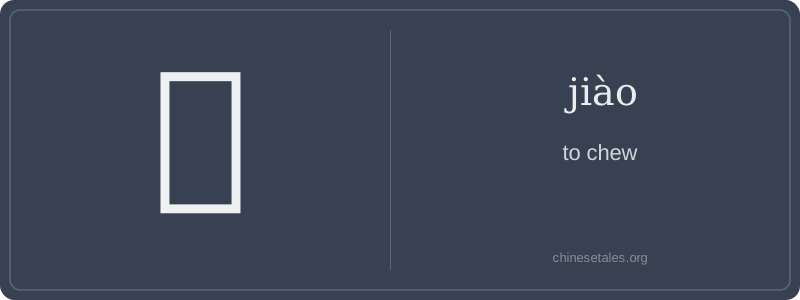
The earliest form of 噌 appears in late Warring States bamboo slips — not as a pictograph, but as a phono-semantic compound. Its left side 口 (kǒu, 'mouth') anchors the meaning domain, while the right side 焦 (jiāo, 'scorched, charred') originally served as the phonetic component. Crucially, 焦 itself evolved from a bronze script glyph depicting a bird atop fire — symbolizing intense heat — and was borrowed for its sound here. Over centuries, the 焦 component simplified: the upper part (隹, 'bird') eroded into ⺈, and the lower fire (灬) became four dots — yielding today’s 15-stroke structure: 口 + ⺈ + 丿 + 灬.
This visual evolution mirrors its semantic journey: from 'mouth + scorched' → 'mouth working intensely' → 'vigorous chewing'. In the Shuōwén Jiězì (121 CE), Xu Shen defined it as 'chewing with audible friction', linking it to the tactile sensation of dry, fibrous foods resisting the teeth. By the Ming dynasty, it appeared in vernacular novels like Jin Ping Mei describing elders chewing medicinal herbs slowly — not for taste, but for ritual duration. The character’s four-dot base (灬) — identical to 'fire' — silently echoes that original sense of internal heat generated by relentless mastication.
Think of 噌 (jiào) as the Chinese equivalent of the English onomatopoeic 'chomp' — but with teeth, tongue, and a little theatrical flair. It doesn’t just mean ‘to chew’ in the bland, nutritional sense; it evokes vigorous, noisy, almost defiant mastication — like someone angrily grinding their molars mid-argument or an elder deliberately chewing betel nut to signal impatience. Unlike generic verbs like 吃 (chī, 'to eat') or 嚼 (jué, 'to chew' — more neutral and common), 噌 carries texture, sound, and attitude.
Grammatically, it’s almost exclusively used in literary or dialectal contexts — rarely in modern spoken Mandarin, and never in HSK materials. It appears mostly as a verb in compound structures (e.g., 噌嚼) or in reduplicated forms (噏噏), and it often takes aspect markers like 着 (zhe) or 了 (le) to indicate ongoing or completed action: 他噏着烟叶,眉头紧锁。('He chews tobacco leaves, brow furrowed.') You’ll almost never see it as a standalone verb in daily speech — trying to say 我噏苹果 would sound archaic or comically overwrought, like saying 'I masticate an apple' at a picnic.
Culturally, 噌 subtly indexes regional identity — it’s still heard in parts of Fujian and Guangdong in folk songs and opera, where chewing betel nut or dried fish is ritualized and expressive. Learners often misread its radical 口 as guaranteeing universal oral action — but 噌 isn’t about speech (like 叫 jiào, 'to shout') or breathing (like 呼 hū); it’s *specifically* about the mechanical, rhythmic work of teeth meeting food. Confusing it with 嚼 (jué) is the #1 trap — they’re semantic cousins, but 噌 is the eccentric uncle who only shows up at weddings and tells stories with mouthfuls.