噌
Character Story & Explanation
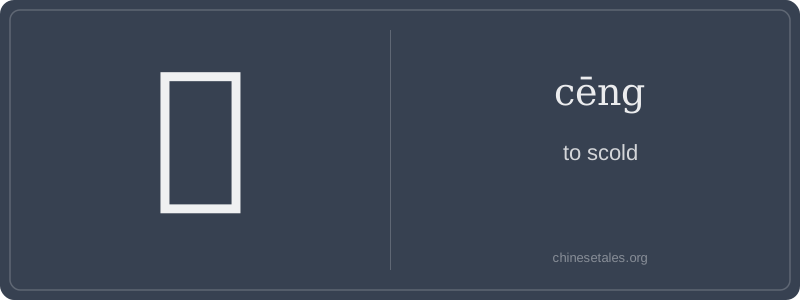
The earliest trace of 噌 appears not in oracle bones but in late Ming–Qing vernacular texts, where it emerged as a phonosemantic compound: the 口 radical signals vocalization, while the right side 曾 (zēng) serves both as a phonetic hint (cēng ≈ zēng, with tone shift) and a subtle semantic anchor — 曾 originally meant 'to layer' or 'to repeat', suggesting the repeated, layered force of a sharp rebuke. Visually, the 15 strokes build tension: three horizontal lines in 曾 evoke stacked intensity, while the compact 口 at left feels like a mouth clamped tight before bursting open — no gentle curve here, just angular precision.
By the Qing dynasty, 噌 had solidified as a literary device for dramatic interruption: in novels like Flowers in the Mirror, characters 'cēng' into arguments mid-sentence, their voices cutting through silence like a knife. Its meaning never broadened — it stayed fiercely specific to that instant of sharp, vocal correction. Interestingly, its visual weight (15 strokes) contrasts with its fleeting usage: it lasts only as long as the syllable 'cēng' — a linguistic micropause charged with social gravity.
At first glance, 噌 (cēng) looks like a mouth 口 shouting something sharp and sudden — and that’s exactly the feeling it carries: a quick, sharp, almost explosive scolding. Unlike formal reprimands (like 批评 pīpíng) or stern lectures (训 xùn), 噌 captures that split-second, visceral burst of rebuke — think a parent snapping 'Don’t touch that!' or a teacher clicking their tongue with a sharp 'Cēng! — hands off the projector!' It’s onomatopoeic in spirit: the sound itself mimics the abrupt, clipped tone of a verbal jab.
Grammatically, 噌 is almost always used as an interjection or verb in colloquial speech — never as a noun or adjective. You’ll hear it in commands like '噌!别跑!' (Cēng! Don’t run!), where it adds urgency and emotional texture. Crucially, it’s rarely used alone in writing; it shines in dialogue or descriptive narration ('他噌地站起来,脸涨得通红' — He shot up from his seat, face blazing red). Learners often mistakenly treat it like a transitive verb ('*I cēng you'), but it doesn’t take an object — it’s an intransitive, action-intensifying particle, closer to 'snap!' or 'bark!' than 'scold'.
Culturally, 噌 reflects Chinese pragmatism in emotional expression: it conveys disapproval without full-blown anger, offering social correction in under half a second. It’s common in northern Mandarin dialects and modern fiction — but absent from formal writing or HSK materials precisely because it’s too vivid, too oral, too *alive*. A classic learner trap? Confusing it with chēng (as in 噌的一声 — cēng de yī shēng, meaning 'with a *twang!*'), where the same character shifts to mimic metallic or stringed sounds — proof that one glyph can hold two distinct sonic worlds.