噇
Character Story & Explanation
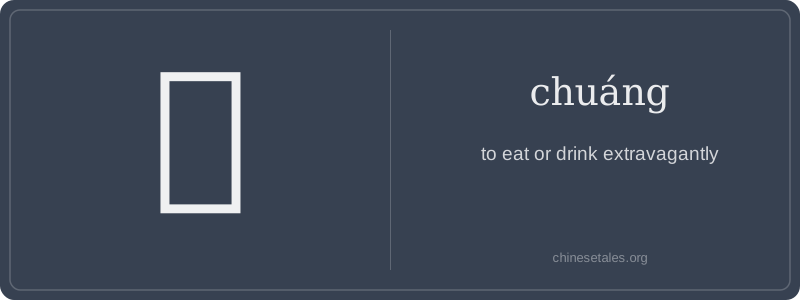
The earliest trace of 噇 appears not in oracle bones but in late Warring States bronze inscriptions and early clerical script, where it emerges as a semantic-phonetic compound: 口 (kǒu, 'mouth') on the left, and 壯 (zhuàng, 'strong, robust') on the right — the latter serving both sound (chuáng is a variant reading of 壯 in ancient dialects) and meaning. The original form emphasized muscular force applied to ingestion: imagine jaws clamping, throat straining, breath roaring — not chewing, but *conquering food*. Over centuries, the right-hand 壯 simplified from its full form (士+爿+丬+彐) into today’s streamlined version, but the sense of bodily power remained etched in every stroke.
By the Han dynasty, 噇 appeared in texts like the *Shuōwén Jiězì* commentary fragments, defined as 'eating with great vigor, as if subduing prey.' In Tang poetry, Li He used it metaphorically: '噇星斗' ('guzzling constellations') — a hyperbolic image of cosmic hunger. Its visual logic is brilliantly literal: mouth + strength = eating so hard it’s athletic. Unlike characters for polite dining (宴, yàn) or quiet sipping (啜, chuò), 噇 refuses elegance — it’s the roar before the burp, the cultural counterpoint to the Confucian ideal of measured conduct.
噇 (chuáng) isn’t just ‘to eat’ — it’s to eat like a dragon at a banquet: extravagantly, noisily, with abandon. It carries the visceral weight of excess — think slurping broth with gusto, cracking bones mid-bite, or downing wine in one fiery gulp. In classical and literary Chinese, it conveys not hunger but *performative indulgence*, often with moral undertones: Confucian texts subtly warn against 噇 as a sign of moral laxity, while Daoist poets sometimes celebrate it as joyful, unselfconscious vitality.
Grammatically, 噇 is almost always transitive and appears in formal or literary contexts — rarely in daily speech. You’ll find it in compounds like 噇酒 (chuáng jiǔ, 'to guzzle wine') or 噇肉 (chuáng ròu, 'to devour meat'), usually paired with nouns denoting rich, heavy, or intoxicating substances. It never stands alone as a verb in modern usage; you won’t say 'I 噇' — instead, it’s embedded: '他噇了三碗酒' (He guzzled three bowls of wine). Learners mistakenly treat it like 吃 or 喝 — but 噇 implies *excess with sensory intensity*, not mere consumption.
Culturally, 噇 reveals how Chinese aesthetics values *restraint in form but richness in implication*. Its very shape — mouth (口) + strength (壯) — shouts 'forceful intake', yet it’s used sparingly, like a rhetorical spice. A common error? Using it in polite company — it’s inherently unrefined. You’d never write 噇茶 ('guzzle tea'); tea demands 慢飲 (màn yǐn, 'sipping slowly'). This character doesn’t describe sustenance — it describes *a moment where appetite overrules decorum*.