哓
Character Story & Explanation
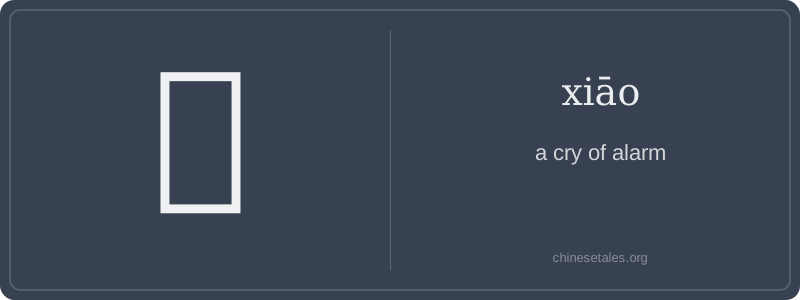
The earliest forms of 哓 are not found in oracle bones (it’s too late for that), but its structure reveals its ancient logic: left side 口 (kǒu, 'mouth') is the semantic anchor — everything about this character is vocal. Right side is 肖 (xiāo), which originally depicted a 'cutting tool' or 'carved likeness' in bronze inscriptions, but by the Han dynasty had phoneticized to serve as the sound component. Visually, 肖 evolved from a pictograph of a knife beside a head (indicating 'carving a likeness'), then simplified to today’s three strokes above two dots — resembling a small, sharp gesture. Combined, 口 + 肖 visually suggests 'a mouth making a sharp, defining sound' — not just any noise, but one that cuts through silence like an alert.
This idea of a 'cutting cry' persisted into classical usage: in the Shuō Yuàn (Garden of Persuasions, c. 17 BCE), 嘵嘵 describes ministers arguing incessantly — their words 'cutting' at each other like quick, repetitive pecks. By Tang poetry, 嘵 took on a gentler nuance: Du Fu used 嘵嘵 to depict birds’ anxious calls before storm, linking sound to foreboding. The character’s visual economy — just nine strokes, yet packing mouth action, sharpness, and repetition — mirrors how Chinese script encodes meaning not just in parts, but in their dynamic relationship.
Imagine hearing a sharp, urgent cry — not a scream of pain, but that startled, high-pitched 'YIKES!' when you nearly step on a snake. That’s 哓 (xiāo): a vivid, onomatopoeic character for a sudden cry of alarm or warning. It doesn’t describe sustained shouting like 叫 (jiào) or angry yelling like 吼 (hǒu); it’s the *instantaneous* vocal burst — breathy, uncontrolled, and instinctive. In classical Chinese, it often appears in reduplicated form (嘵嘵) to evoke persistent, fretful chatter — think of a nervous bird flitting between branches, chirping anxiously.
Grammatically, 哓 is almost always used in compounds or reduplications — you’ll rarely see it alone in modern writing. It functions as a verb stem (e.g., 嘵叫) or an adverbial modifier (嘵嘵不休), but never as a standalone noun or independent verb. Learners sometimes mistakenly use it like ‘shout’ in English ('He 哓ed!'), but that’s ungrammatical — it needs support: 嘵嘵地喊, 嘵叫, or 嘵嘵不止. Its tone (xiāo, first tone) is bright and rising, mirroring the upward lilt of an alarmed voice.
Culturally, 哓 carries a faint literary or slightly archaic flavor — it appears more in poetry, classical allusions, or stylized prose than in daily WeChat chats. A common mistake is overusing it thinking it’s ‘stronger’ than 叫; in reality, it’s *more specific* and *less forceful*. Also, don’t confuse its mouth radical (口) with emotional intensity — this isn’t rage, it’s reflexive alarm. Think of it as the linguistic equivalent of jumping back and gasping: visceral, brief, and deeply human.