叽
Character Story & Explanation
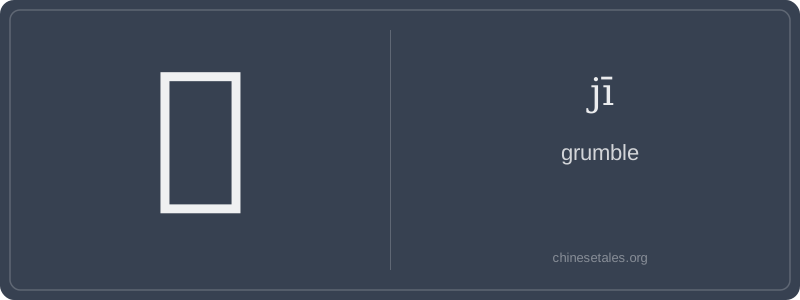
Oracle bone inscriptions show no direct precursor to 叽 — it’s a later invention, born during the Warring States or early Han period as Chinese expanded its toolkit for capturing everyday sounds. Its modern form is brilliantly minimal: 口 (kǒu, ‘mouth’) + 几 (jī, ‘small table’), but here 几 isn’t literal — it’s a phonetic component borrowed for its sound, not its meaning. Visually, the five strokes sketch a mouth with two quick, jagged strokes above (the ‘几’) suggesting rapid, staccato vibration — like lips fluttering mid-grumble. No ancient pictograph of a bird or insect inspired it; this is pure linguistic engineering: mouth + sound-symbol = audible pettiness.
The character first appears in vernacular texts of the Ming dynasty, notably in novels like Jin Ping Mei, where maids ‘叽叽咕咕’ behind fans — their whispers coded as harmless noise. By the Qing, it had crystallized into a marker of low-stakes vocalization: not shouting, not weeping, but *grumbling*. Its visual simplicity (just 5 strokes!) mirrors its semantic humility — it doesn’t claim gravity; it just *vibrates*. Even today, its shape invites you to ‘feel’ the sound: open your mouth (口), then flick your tongue twice (the two strokes of 几) — there’s the jī jī!
Think of 叽 (jī) as the linguistic equivalent of a tiny, persistent mosquito — not loud or aggressive, but an irksome, high-pitched grumble that won’t quit. It’s an onomatopoeic verb meaning ‘to grumble’ or ‘to mutter discontentedly’, usually under one’s breath and often in a petty, nagging, or childish way. Unlike formal synonyms like 抱怨 (bào yuàn), 叽 carries a light, almost cartoonish tone — it’s what a toddler does when denied candy, or what a cat does before swatting at your hand: soft, repetitive, and slightly absurd.
Grammatically, 叽 is almost always used reduplicated (叽叽) or in compound verbs like 叽叽咕咕 (jī jī gū gū) — never alone. You’ll rarely see it as a standalone verb; instead, it thrives in descriptive phrases: 叽叽喳喳 (jī jī zhā zhā) for chattering, or 叽里呱啦 (jī lǐ guā lā) for rapid, incomprehensible speech. Learners often mistakenly treat it like a full-verb — trying to say *‘他叽’* — but that’s unnatural; it needs rhythm, repetition, or pairing to sound native.
Culturally, 叽 evokes warmth and familiarity, not anger — it’s the sound of old aunties gossiping over tea, not courtroom lawyers arguing. Its lightness makes it safe for self-deprecation (e.g., ‘我叽叽歪歪了一下午’ — ‘I grumbled pointlessly all afternoon’) but risky if misused in formal writing. A common mistake? Confusing it with similar-sounding characters like 饥 (jī, ‘hungry’) — remember: 叽 has a mouth (口) because it’s about *sound*, not stomachs.