嘬
Character Story & Explanation
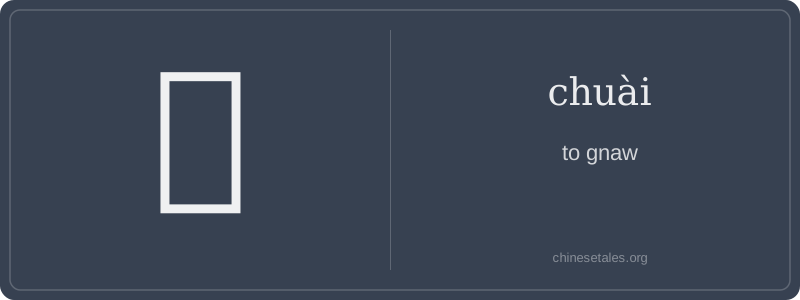
The earliest form of 嘬 appears in late Warring States bamboo texts as a compound pictograph: a mouth (口) on the left, and 取 (qǔ, ‘to take’) on the right — not today’s 最. Over time, 取 evolved graphically into 最 (zuì, ‘most’), likely due to phonetic borrowing and clerical script simplification. The mouth radical stayed put, anchoring the meaning firmly to oral action, while the right side morphed from ‘taking with hands’ into a shape evoking ‘utmost effort’ — perfectly fitting the relentless, tooth-driven action of gnawing.
This visual shift mirrors semantic deepening: from generic ‘oral taking’ to highly specific ‘biting with concentrated force’. In the Classic of Poetry (Shījīng), similar verbs describe animals gnawing timber or roots — though 嘬 itself appears later, notably in Tang dynasty poetry and Song dynasty medical texts describing infant feeding reflexes. Its form — mouth + ‘most’ — quietly insists: this isn’t nibbling. This is *the utmost bite*.
At its core, 嘬 (chuài) isn’t just ‘to gnaw’ — it’s the visceral, almost primal act of biting *repeatedly*, with grit and persistence: think rodents gnawing wood, a baby suckling stubbornly, or someone chewing through tough jerky. It carries a tactile, slightly rough texture in Chinese — not polite dining, but survival, instinct, or quiet tenacity. You’ll rarely hear it in casual speech today; it’s literary, poetic, or dialectal, often appearing in classical allusions or regional storytelling.
Grammatically, 嘬 is a transitive verb that usually takes a concrete object (e.g., 嘬骨头 chuài gǔtou — 'gnaw bones') and frequently appears in reduplicated form (嘖嘖 chuài chuài) to emphasize rhythmic, sustained action. Unlike common verbs like 吃 (chī) or 啃 (kěn), 嘬 implies *focused pressure with the front teeth*, not swallowing — so you can 嘬 a bone but not 嘬 a soup. Learners sometimes misread it as zuō (a rare variant in archaic compounds like 嘬吮 zuō shǔn), but chuài is the standard modern reading for ‘gnaw’.
Culturally, this character reflects how Chinese lexical precision captures subtle physical distinctions: the mouth radical (口) anchors it to oral action, while the right side (最) hints at extremity — literally ‘the most’ — suggesting *maximum effort in biting*. It’s a fossil of embodied language: no abstract metaphor here, just teeth on matter. Mistake it for 啃 (kěn, also ‘gnaw’) and you’ll sound oddly archaic — 啃 is everyday; 嘬 is a whisper from a Ming dynasty scroll.