嘧
Character Story & Explanation
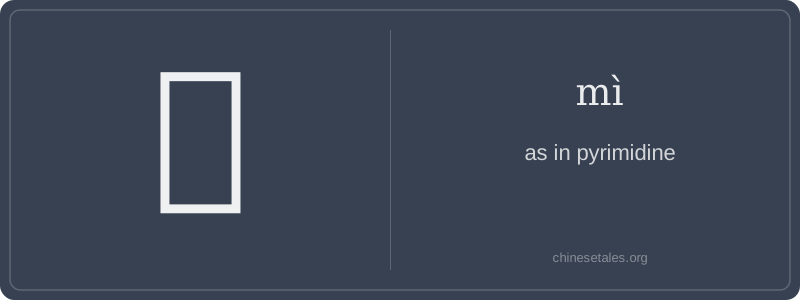
嘧 has no ancient oracle bone or bronze script ancestry — it’s a deliberate 20th-century neologism, invented by Chinese chemists during the wave of scientific terminology standardization in the 1930s–40s. Its structure is entirely rational: left side 口 (the 'naming' radical, used for terms denoting abstract categories or proper names), right side 密 (mì, 'dense', 'close-knit'), chosen both for sound and conceptual resonance — pyrimidine’s fused ring structure *is* remarkably dense and tightly packed. The 14 strokes were carefully calibrated: 3 for 口, 11 for 密 (itself composed of 宀 + 秘 without the 示), ensuring visual balance and typographic clarity in printed scientific texts.
Historically, 嘧 bypassed classical literature entirely — you won’t find it in the Analects, Tang poetry, or even late Qing encyclopedias. Its first appearances are in 1935–1947 biochemical glossaries published by the Academia Sinica. Yet its design honors tradition: the choice of 密 echoes classical associations with secrecy and intricacy (as in 神秘 — 'mysterious'), subtly framing molecular biology as a newly revealed, deeply intricate realm of knowledge. Visually, the tight enclosure of 口 around the compact 密 mirrors how pyrimidine’s ring 'encloses' nitrogen atoms — a rare case where modern scientific semantics harmonize with ancient graphic logic.
Don’t let the mouth radical (口) fool you — 嘧 isn’t about speaking, eating, or shouting. It’s a modern scientific loan character, born in the 20th century to translate the English chemical term 'pyrimidine'. Its core meaning is purely technical: it names a six-membered nitrogen-containing aromatic ring that forms the backbone of DNA/RNA bases like cytosine, thymine, and uracil. In Chinese, it appears almost exclusively in compound words — never alone, never in daily speech — and always carries the quiet authority of biochemistry labs and pharmacology textbooks.
Grammatically, 嘧 functions only as a bound morpheme: it must pair with other characters (like 啶, 哒, or 嗪) to form valid terms. You’ll never say '嘧!' like you’d say '啊!' — it has no interjectional, verbal, or independent use. Learners sometimes mistakenly treat it like a regular noun and try to pluralize it or add aspect particles (e.g., *嘧了, *嘧过), but it resists all such attempts — it’s a linguistic fossil frozen in its scientific role.
Culturally, 嘧 is a fascinating example of how Chinese absorbs foreign concepts *without* phonetic transliteration — instead, it crafts new characters using semantic radicals (口 suggests 'name', 'designation') and phonetic components (密 mì hints at pronunciation while subtly evoking 'density' or 'tight structure', mirroring pyrimidine’s compact ring). A common mistake? Assuming 口 means 'mouth-related' — here, it’s purely conventional, like the 口 in 名 (name) or 各 (each). This character doesn’t speak; it labels, precisely and silently.