嘦
Character Story & Explanation
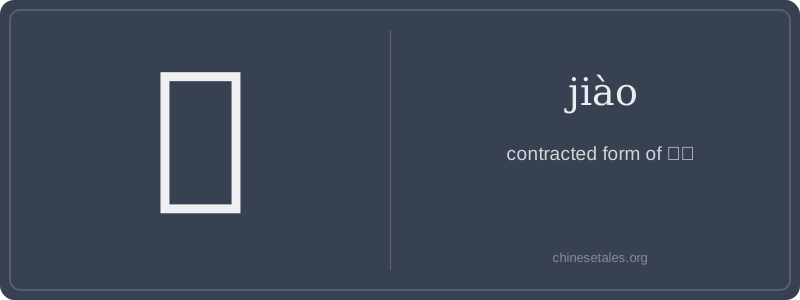
嘦 has no ancient origin — it doesn’t appear in oracle bone, bronze, or seal scripts. It emerged organically in late imperial and modern cursive handwriting as a ligature: scribes began fusing the left radical of 只 (the ‘mouth’ radical 口, written small and high) with the top-left stroke of 要 (whose top is , historically derived from 西). Over time, this hurried connection — a downward hook from 口 linking into 要’s upper loop — solidified into a single, compact glyph. Its shape isn’t pictographic; it’s calligraphic: the result of speed, repetition, and visual economy on paper or screen.
This character is a rare case of a *living ligature* — not preserved in dictionaries as standard, yet actively created and recognized by millions. It appears in early 20th-century vernacular literature (e.g., Lu Xun’s informal letters) and exploded with digital messaging, where typing ‘zhiyao’ auto-suggests 嘦 as a stylistic option. Visually, it looks like 口 + 要, but structurally, it’s a fused whole — the 口 isn’t ‘speaking’, it’s ‘signaling’ the verbal nature of the condition. Its meaning didn’t evolve semantically; it inherited 只要’s logic entirely — but gained emotional texture: softer, more personal, less bureaucratic than its two-character parent.
嘦 isn’t a ‘real’ character in the traditional sense — it’s a handwritten contraction, like English’s ‘don’t’ or ‘gonna’. It carries the warm, conversational weight of spoken Mandarin: not formal, not literary, but deeply human. It means ‘as long as’ or ‘so long as’, compressing 只要 (zhǐ yào) into one fluid glyph — and that compression tells us something essential about Chinese communication: efficiency with intimacy. You won’t find 嘦 in official documents or exams (it’s absent from HSK), but you’ll see it in WeChat messages, diary entries, song lyrics, and subtitles where tone matters more than orthodoxy.
Grammatically, it functions identically to 只要 — introducing a sufficient condition clause before the main clause. For example: ‘嘦你來,我就開心’ (jiào nǐ lái, wǒ jiù kāi xīn) = ‘As long as you come, I’ll be happy.’ Note the crucial word order: 嘦 must come *before* the condition, never after — unlike English ‘as long as’, which can float. Learners sometimes mistakenly treat it as a standalone adverb (‘just’), but it’s strictly a conjunction — and always requires a second clause to complete its logic.
Culturally, 嘦 reveals how Chinese speakers value pragmatic elegance: why write two characters when one gesture — a quick fusion of 口 (mouth/speech) and 要 — says the same thing with more soul? It’s banned in formal writing, yet embraced in poetry and pop culture for its rhythmic lightness. A common mistake is overusing it in essays or mixing it up with similar-looking characters — but its power lies precisely in its deliberate informality: it’s the linguistic equivalent of a knowing wink.