嘥
Character Story & Explanation
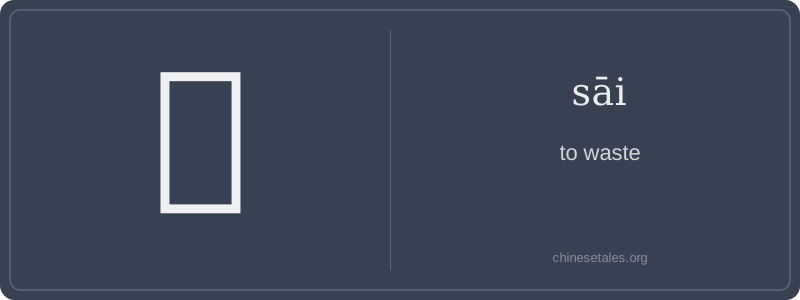
The character 嘥 doesn’t appear in ancient oracle bone or bronze inscriptions — it’s a late, regional creation. Its earliest attested form emerges in Ming–Qing vernacular literature and Cantonese opera scripts as a phonetic-semantic compound: the left side 口 (kǒu, 'mouth') signals speech or vocalization, while the right side 塞 (sāi, 'to stuff/block') provides both sound and meaning — visualizing something jammed, choked, or obstructed, like breath or effort going nowhere. Over centuries, the right component simplified from 塞 to 赛 (sài) and finally to the modern 嘥, retaining its oral, colloquial flavor.
This evolution mirrors its semantic journey: from the concrete image of 'stuffing up a channel' (causing blockage → inefficiency) to the abstract idea of 'squandering'. In classical texts, it’s absent — but in late Qing Cantonese folk songs and early 20th-century Hong Kong street pamphlets, 嘥 appears vividly in lines like '莫嘥青春' (Don’t squander your youth!), linking wasted time directly to lost vitality. Its mouth radical reinforces that this is a word meant to be *said*, not silently read — a linguistic shrug, a sigh made visible.
Imagine your Cantonese uncle watching you scroll mindlessly through social media for 45 minutes, then sighing, 'Ai ya, 你又嘥時間啦!' — that sharp, slightly scolding 'sāi' hits like a tiny splash of cold tea: it’s not just 'waste' in the abstract sense — it’s wastefulness with moral weight, implying recklessness, laziness, or poor judgment. 嘥 is almost exclusively used in spoken Cantonese (especially Hong Kong and Guangdong), carrying a tone of gentle reproach or weary exasperation. You’ll rarely see it in formal Mandarin writing — it’s the character equivalent of a raised eyebrow over dim sum.
Grammatically, 嘥 is a transitive verb that *must* take an object: 嘥時間 (sāi shí jiān), 嘥錢 (sāi qián), 嘥氣力 (sāi qì lì). It never stands alone. Unlike Mandarin 浪費 (làngfèi), which can be neutral or even bureaucratic ('waste resources'), 嘥 always feels personal and visceral — like watching steam rise uselessly from a forgotten teapot. Learners often mistakenly try to use it in Mandarin contexts or without an object, triggering polite confusion.
Culturally, 嘥 reflects Southern Chinese pragmatism: time, money, energy — all are finite, tangible things you hold in your hands, not abstractions. Using 嘥 signals you’re speaking *with* the speaker’s values, not just *about* them. A common mistake? Confusing it with the Mandarin-only 糟蹋 (zāotà) — which implies degradation or defilement, not simple inefficiency. 嘥 isn’t about ruining something sacred; it’s about letting good rice go cold while you stare at your phone.