嘣
Character Story & Explanation
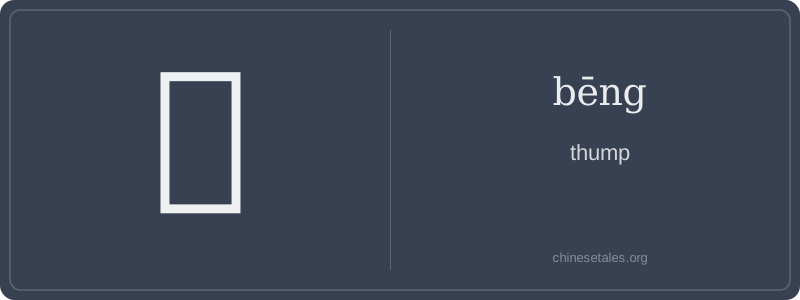
The earliest ancestor of 嘣 isn’t found in oracle bones — it’s a latecomer, born from linguistic necessity. Its structure is brilliantly transparent: 口 (kǒu, ‘mouth’) on the left signals ‘sound produced by speech or impact’, while the right side, 棚 (péng), was borrowed purely for its sound (bēng), though 棚 itself means ‘shed’ or ‘scaffold’. In fact, 棚 evolved from 朋 (péng, ‘friend’, originally picturing two shells — currency — implying ‘pair’), then gained the wood radical 木. So 嘣 is a phonosemantic compound: mouth + ‘peng’-sound — no ancient pictograph, just clever, pragmatic sound-mimicking engineering.
Its meaning crystallized during the Ming-Qing vernacular fiction boom, where authors needed punchy, kinetic sound words for martial arts clashes, firecrackers, and slapstick. You’ll find ‘嘣’ in 19th-century operatic scripts and early 20th-century comic strips — always signaling abrupt, attention-grabbing rupture. The visual weight of its 14 strokes mirrors its acoustic impact: dense, decisive, and impossible to ignore — a written explosion.
嘣 (bēng) isn’t just ‘thump’ — it’s the sound of sudden, percussive finality: a door slamming shut, a balloon bursting, or a cartoon character bonking their head. It’s an onomatopoeic gem that lives entirely in the ear and the mouth: the ‘b-’ start is explosive, the ‘-ēng’ resonates like a struck gong, and the 口 (mouth) radical tells you instantly this is *spoken sound*, not abstract meaning. Chinese doesn’t treat onomatopoeia as decorative fluff — it’s grammatically active, often acting as an adverbial verb complement (e.g., ‘门关得嘣一声’) or even a standalone sentence (‘嘣!’), packing visceral immediacy into one syllable.
Grammatically, 嘣 almost never stands alone as a verb — you won’t say ‘他嘣了一下’; instead, it appears in fixed patterns: ‘嘣的一声’ (a sharp *thump!*), ‘嘣嘣’ (repeated for rhythmic or mechanical sounds), or fused in compound verbs like ‘嘣开’ (to burst open with a bang). Learners often mistakenly try to use it like English ‘thump’ — as a transitive verb — but it functions more like an auditory exclamation point, anchoring the sensory moment.
Culturally, 嘣 reflects how Chinese prioritizes *embodied listening*: sound isn’t background noise — it’s narrative punctuation. Think of traditional storytelling (pingshu), where a single ‘嘣!’ cues a plot twist or physical impact. A common mistake? Overusing it in writing — it’s vivid but colloquial and slightly playful, rarely appearing in formal reports or essays. Also, don’t confuse its tone: bēng (first tone) is essential — běng (third tone) means ‘stiff’ and is unrelated.