嘢
Character Story & Explanation
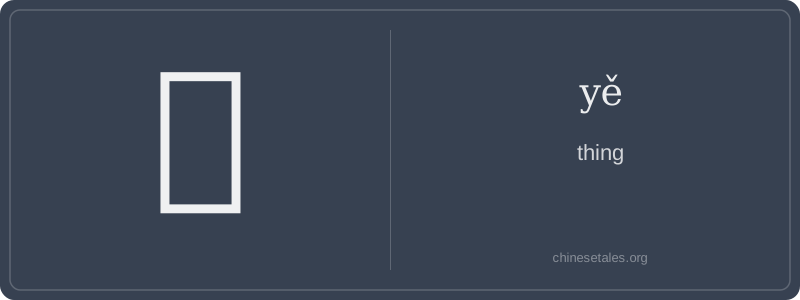
The character 嘢 has no ancient oracle bone or bronze script origin — it’s a relatively late folk creation, born in Southern China during the Ming–Qing period. Its form cleverly fuses 口 (kǒu, 'mouth') on the left — signaling spoken, colloquial language — and 野 (yě, 'wilderness', 'unrestrained') on the right, which itself evolved from a pictograph of a deer (鹿) beside a mound (土), suggesting untamed terrain. Over centuries, 野 was simplified and stylized, losing its deer antlers and gaining the 里 component, while the 口 radical anchored it to speech. The full character thus visually whispers: 'a word sprung from wild, everyday talk' — not scholar’s ink, but market-stall banter.
This makes sense historically: 嘢 emerged as a phonetic loan character (jiǎjiè) for the Cantonese word /jɛː˥/ meaning 'thing', filling a lexical gap where classical Chinese used 物 (wù) or 事 (shì), too stiff for casual use. Unlike classical characters refined over dynasties, 嘢 was grassroots — first scribbled in opera scripts and street pamphlets, then cemented by 20th-century Hong Kong cinema. Its visual 'mouth + wild' composition isn’t symbolic of meaning per se, but of *origin*: oral, regional, unpolished — a rare case where the character’s structure tells you exactly where (and how loudly) it was born.
Here’s the twist: 嘢 (yě) isn’t standard Mandarin — it’s a Cantonese colloquial character, rarely seen in formal writing or mainland textbooks. Its core meaning is 'thing' (like 'stuff', 'gadget', or 'what’s-this?'), but it carries a playful, slightly cheeky, often diminutive tone — think 'this little thing here' or 'that doodad over there'. Unlike standard Mandarin’s 东西 (dōngxi), 嘢 feels tactile and immediate, almost like you’re poking something with your finger while saying it.
Grammatically, it’s a noun suffix or standalone noun, commonly used after demonstratives (呢嘢 nī yě = 'this thing', 嗰嘢 gǒ yě = 'that thing') or in exclamatory phrases (咩嘢? me1 yě? = 'What thing?!' → 'What?!'). Learners often mistakenly pronounce it as yě (Mandarin ‘also’) — a classic trap! It’s never used in subject-predicate constructions like standard nouns; you won’t say '嘢 is red' — instead, it’s embedded in Cantonese-specific frames: '你睇下呢嘢!' (Look at this thing!).
Culturally, 嘢 thrives in Hong Kong street speech, slang, and pop lyrics — it’s the linguistic equivalent of a raised eyebrow or a knowing wink. Mainland learners rarely encounter it unless watching Cantopop or chatting with Cantonese friends. A big mistake? Using it in formal essays or assuming it’s interchangeable with 东西 — that’s like using 'gizmo' in a UN resolution. Also, don’t confuse its pronunciation: in Cantonese, it’s actually [jɛː˩] (Jyutping: je5), not Mandarin yě — tone and vowel differ sharply!