嘡
Character Story & Explanation
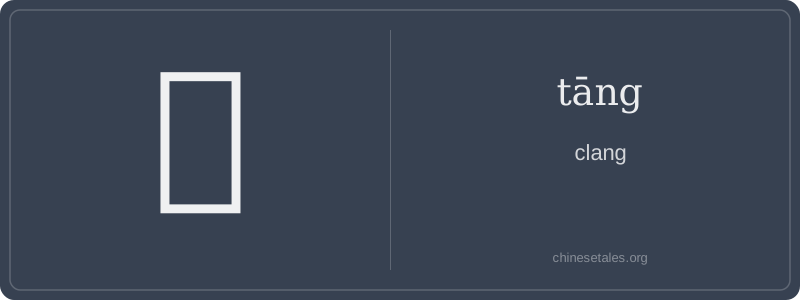
The character 嘡 has no oracle bone or bronze script origin — it’s a latecomer, invented during the Ming–Qing transition as vernacular literature exploded. Its left side 口 (mouth radical) was standard for sound words, but its right side 唐 wasn’t borrowed from ancient phonetics — it was chosen for its pronunciation (táng) and evocative weight: 唐 also meant 'grand', 'resounding', and appeared in classical terms like 唐风 ('Tang style', implying majestic sonority). Scribes combined them deliberately: 口 + 唐 = the very idea of a large, ringing, authoritative sound — not just any clang, but one with presence and cultural heft.
By the 18th century, 嘡 thrived in storytellers’ scripts and woodblock-printed novels, especially in scenes involving temple bells, blacksmith hammers, or imperial gongs. Unlike earlier sound characters (like 啊 or 哎), 嘡 carries dignity — it’s never silly or weak. In Pu Songling’s *Strange Tales*, a ghost’s entrance is marked by '嘡然一声', signaling not fright but solemn inevitability. Visually, its balanced structure (7 strokes on left, 10 on right) mirrors the way a clang begins sharply and lingers — the 口 initiates, the 唐 sustains.
嘡 is pure onomatopoeia — it doesn’t describe sound abstractly; it *is* the sound: a sharp, metallic, resonant CLANG, like a gong struck with authority or a temple bell hit at dawn. In Chinese, such characters aren’t just decorative — they’re sensory verbs that anchor scenes in visceral reality. You’ll rarely see 嘡 alone; it almost always appears reduplicated (嘡嘡) or paired with other sound words (嘡啷, 嘡当) to amplify rhythm and emotional texture. It’s not a ‘word’ you conjugate — it’s a sonic brushstroke.
Grammatically, 嘡 functions as an adverbial modifier (e.g., 嘡地一声) or as part of a fixed mimetic phrase. Learners often mistakenly treat it like a verb ('to clang') and try to add aspect particles (了, 过) — but that breaks natural usage. Instead, it’s embedded in structures like 'A + 嘡 + B' (e.g., 钟声嘡嘡响起) or used in literary descriptions where sound triggers atmosphere: a sudden 嘡 can signal danger, ritual, or comic interruption.
Culturally, 嘡 belongs to China’s rich tradition of 'sound-script' — characters born from auditory experience rather than visual logic. Unlike English, which borrows Latin roots for technical terms, Chinese often builds meaning directly from the ear: the mouth radical (口) signals vocalization or sound emission, while the right side (唐) hints at resonance (as in 唐音 — 'resonant tone'). Non-native speakers may overlook how deeply such characters shape narrative pacing — especially in opera scripts, martial arts novels, or children’s stories where sound drives action.