嘟
Character Story & Explanation
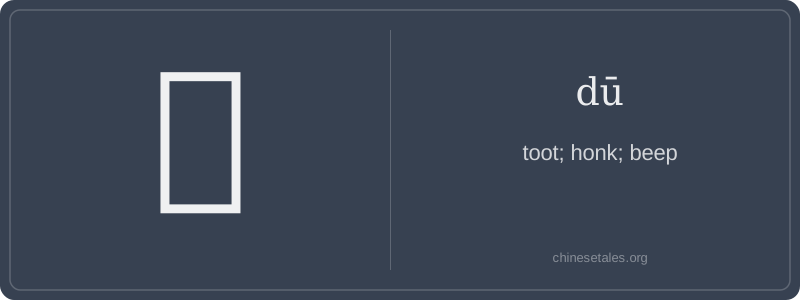
The earliest form of 嘟 appears in late clerical script (c. 1st century CE), not oracle bones — it’s a relatively young character. Visually, it’s a brilliant stroke-by-stroke mimicry: left side 口 (kǒu, ‘mouth’) sets the domain; right side 都 (dū, ‘all, entire’) provides both sound (*phonetic loan*) and subtle semantic weight — because ‘all’ of your breath is pushed out in one compact, pressurized burst. The 13 strokes map perfectly: 3 for 口 (vertical, horizontal折, closing hook), then 10 for 都 — including the distinctive ‘city wall’ 广 top and the flowing ‘foot’ 足 below, evoking something urgent, mobile, and slightly unruly.
By the Tang dynasty, 嘟 was solidifying as an onomatopoeic marker for short, blunt, voiced consonant sounds — especially those made with lips tightly closed then released (like /d/ + /u/). Unlike classical characters tied to ritual or philosophy, 嘟 emerged from street speech and children’s babble. It appears rarely in pre-modern texts but explodes in 20th-century fiction — Lao She uses 嘟囔 in Rickshaw Boy to capture Beijing rickshaw pullers’ weary, half-audible complaints. Its shape doesn’t depict an object — it *performs* the sound: tight mouth + full-body exhalation = dū.
Think of 嘟 (dū) as Chinese onomatopoeia’s punk-rock cousin — it’s not just a sound, it’s a *squeaky protest*. Unlike English ‘beep’ (which feels sterile and digital), 嘟 carries attitude: it’s the grumpy toot of an old bicycle horn, the impatient ‘dū!’ of a taxi driver in Shanghai rush hour, or even a child’s pouty lip-buzzing ‘dū—’ when refusing broccoli. It’s visceral, breathy, and always mouth-driven — which makes perfect sense, since its radical is 口 (mouth).
Grammatically, 嘟 almost never stands alone. You’ll see it reduplicated as 嘟嘟 (dū dū) for sustained or repeated sounds (like a car horn), or paired with verbs like 嘟囔 (dū nang) — meaning ‘to mutter under one’s breath’, where the first syllable captures that low, nasal, barely-audible vibration. Learners often misplace tones (saying dǔ instead of dū) or overuse it like English ‘beep’, forgetting that 嘟 implies *intentional, expressive sound* — not neutral signaling. A microwave ‘ding’? Use 叮 (dīng). A frustrated sigh-hum? That’s 嘟.
Culturally, 嘟嘟 is the sound of urban rhythm — you’ll hear it in cartoon sound effects, parenting blogs describing toddler tantrums (‘他嘟着嘴不说话’), and even in pop lyrics mocking bureaucratic inefficiency (‘电话嘟嘟响,没人接’). Mistake it for a formal word, and you’ll sound like you’re narrating a Looney Tunes short — charming, but not for a business email!