嘞
Character Story & Explanation
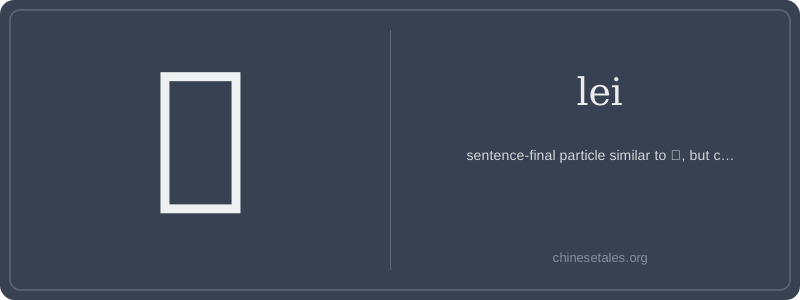
嘞 has no oracle bone or bronze script ancestry — it’s a latecomer, born in the Ming-Qing transition as a phonetic loan character. Its form fuses 口 (kǒu, 'mouth', signaling speech) with 勒 (lè, 'to rein in', but here used purely for sound: léi). Early printed vernacular novels like The Plum in the Golden Vase (c. 1610) show variants like '嘞' and '唻' emerging in dialogue tags to capture the rising, approving tone of colloquial speech — visual shorthand for a vocal inflection that couldn’t be written with classical particles.
By the Qing dynasty, 嘞 stabilized as the standard written form for this specific particle, especially in regional opera scripts and folk narratives where tone mattered more than grammar. Its mouth radical anchors it firmly in spoken language, while the '勒' component — though semantically empty — evokes control and completion (like pulling reins to halt a horse), subtly reinforcing its function: marking a pleasing, intentional endpoint. No classical dictionary lists it as a formal particle; it rose from the street, not the scholar’s desk — a testament to how Mandarin’s living voice constantly reshapes its own writing system.
Think of 嘞 (léi) as the cheerful, thumbs-up cousin of 了 (le). While 了 simply marks a change of state — neutral and factual — 嘞 adds warmth, affirmation, and quiet delight: 'Yes! And it’s good!' It’s not grammatically required like 了; instead, it’s sprinkled at the end of statements to convey gentle approval, satisfied closure, or affectionate acknowledgment — like saying 'There you go!' or 'All set!' with a smile. You’ll hear it often in southern China, Taiwan, and in warm, intimate speech: 'Cup of tea? Done! ☕️' → '茶泡好嘞!'
Grammatically, 嘞 only appears sentence-finally (never mid-sentence), attaches to completed actions or states, and almost always follows verbs or adjectives — never nouns alone. Crucially, it cannot replace 了 in past-tense marking: '我吃了' (I ate) ≠ '我吃嘞' (nonsensical). But '饭煮好嘞!' (The rice is cooked — and it’s perfect!) works beautifully. Learners often overuse it trying to sound 'native,' but native speakers reserve it for moments of light-hearted validation — never urgency, formality, or complaint.
Culturally, 嘞 carries a cozy, oral tradition vibe: it thrives in spoken dialects (especially Min Nan-influenced Mandarin), storytelling, and nurturing contexts (grandmas, baristas, shopkeepers). It’s rarely written — which explains why it’s absent from HSK — yet instantly recognizable by ear. A classic mistake? Confusing it with 啦 (la), which is more exclamation-heavy and socially expansive ('Let’s go啦!'), whereas 嘞 is quieter, more personal, and grounded in satisfaction — less 'Yay!' and more 'Ah… just right.'