唛
Character Story & Explanation
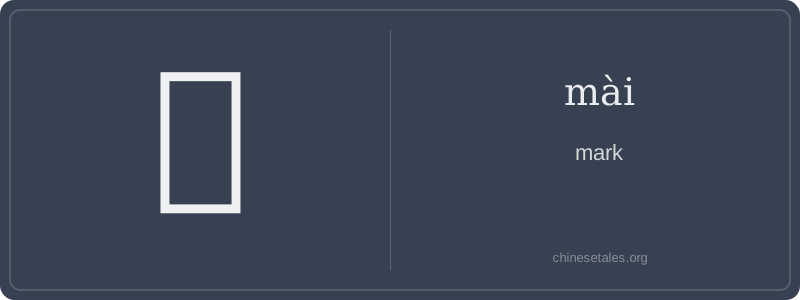
The character 唛 has no ancient origin — it’s a modern invention, likely coined in the 1920s–30s by bilingual clerks in Shanghai’s foreign concessions. There’s no oracle bone or bronze script form because it didn’t exist before the Republic era. Visually, it’s a clever minimalist construction: 口 (kǒu, mouth radical) on the left provides familiar structural grounding, while the right side 麦 (mài, wheat) supplies both pronunciation and a subtle semantic nudge — wheat was a key export commodity, and ‘mark’ often appeared on burlap sacks of grain. Stroke-by-stroke, it’s efficient: 口 (3 strokes) + 麦 (7 strokes) = 10 total — clean, legible, and typeface-friendly for invoices and shipping manifests.
Its meaning never evolved organically; it was assigned and stabilized from day one. Unlike classical characters that accrued layers of metaphor over millennia, 唛 stayed narrowly functional — a linguistic barcode. You won’t find it in the Shuōwén Jiězì or Tang poetry. Instead, it appears in 1930s customs regulations and 1950s factory manuals. Interestingly, its visual pairing with 麦 subtly reinforces reliability: wheat symbolizes sustenance and trustworthiness in Chinese culture, so ‘mark + wheat’ quietly implies ‘a mark you can count on’ — an unintended but enduring cultural resonance.
At first glance, 唛 looks like a straightforward loanword character — and it is! Unlike most Chinese characters rooted in ancient semantics or pictography, 唛 is a phonetic-loan (音译字) created in early 20th-century Shanghai to write the English word 'mark' — as in brand mark, trademark, or shipping label. Its meaning isn’t derived from its components but from sound-matching: mài approximates the English /mɑːrk/. So while 口 (mouth radical) usually hints at speech or utterance, here it’s purely decorative scaffolding — a visual anchor for a foreign concept being naturalized into Chinese script.
Grammatically, 唛 appears almost exclusively in compound nouns, never alone. You’ll see it in industrial, commercial, or logistics contexts: ‘唛头’ (mài tóu, shipping mark), ‘外唛’ (wài mài, outer label), or ‘内唛’ (nèi mài, inner label). It doesn’t conjugate, doesn’t take aspect particles, and never functions as a verb or adjective — it’s a lexical fossil, frozen in technical usage. Learners often mistakenly try to use it like 标记 (biāojì, 'to mark') or assume it carries semantic weight — but no: it’s a silent placeholder, a linguistic passport stamp for English terminology.
Culturally, 唛 reveals how Chinese absorbs foreign concepts not by translation, but by transcription — prioritizing phonetic fidelity over meaning when precision matters in trade. It’s a quiet testament to Shanghai’s cosmopolitan history: this character thrived in treaty-port warehouses, not Confucian academies. A common learner trap? Using 唛 where 标 or 标志 would be natural — e.g., saying *‘这个产品有唛’ instead of ‘这个产品有标志’. Native speakers instantly flag that as jargon-heavy or overly technical — like saying ‘this product has a SKU’ instead of ‘this product has a label’.