嘚
Character Story & Explanation
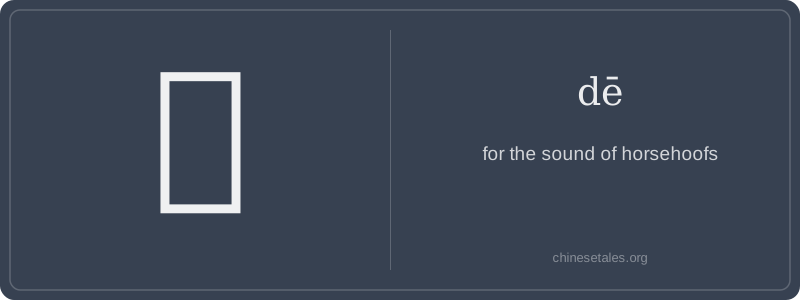
The earliest ancestor of 嘚 isn’t found in oracle bones — it’s a latecomer, born from phonetic borrowing and visual logic during the late imperial era. Its structure is brilliantly transparent: left side 口 (kǒu, 'mouth') signals it’s a spoken/sounded word; right side 得 (dé, 'to obtain') provides the pronunciation clue (dē is a tonal variant of dé). Originally, scribes needed a way to write the galloping sound heard in folk songs and horse-drawn cart tales — so they combined 口 + 得, repurposing 得’s sound while ignoring its meaning. Stroke by stroke, the modern form emerged: the compact 口 (3 strokes), then 得’s components — 彳 (2 strokes), 日 (4 strokes), and 羊 missing the dot, simplified to 一 and 丶 (5 strokes), totaling 14.
This character’s evolution reflects how Chinese embraces functional creativity: no ancient pictograph was needed — just clever component reuse. Though absent from classical texts like the *Shijing*, 嘚 appears vividly in Qing-dynasty vernacular novels and 20th-century folk operas where horseback messengers or runaway steeds demanded sonic authenticity. Its visual symmetry — balanced yet dynamic — mirrors the very rhythm it names: two short beats (口 + the quick flick of 得’s tail stroke) echoing the double-tap of iron-shod hooves on cobblestone.
Meet 嘚 (dē) — the onomatopoeic spark that brings galloping horses to life in Chinese writing! Unlike English’s 'clip-clop' or 'clop-clop', 嘚 captures the sharp, rhythmic, slightly metallic *tink-tink-tink* of hooves on stone — think a spirited trot down an old Beijing alley, not a thunderous charge. It’s purely sound-based and emotionally charged: it evokes urgency, excitement, or even playful mischief — never just neutral description.
Grammatically, 嘚 is almost always reduplicated as 嘚嘚 (dē dē) and functions as an adverb or interjection, often placed at the beginning or middle of a sentence to set the scene or punctuate action. You’ll hear it in storytelling ('嘚嘚!马儿跑远了。'), children’s books, or vivid narration — but almost never in formal speech or writing. Learners sometimes mistakenly use it like a verb ('他嘚嘚马') — nope! It doesn’t *do* anything; it *sounds* something. Also, don’t confuse its tone: it’s always first tone dē — never de (light tone) or dě (third tone).
Culturally, 嘚 is a linguistic fossil with flair: it survives because it fills a niche no other character does — that precise, crisp, staccato hoofbeat. While rare in daily adult conversation, it’s beloved in oral traditions, animation scripts, and internet memes (e.g., '嘚嘚嘚,老板又来了!' to mimic frantic typing or rushing). A common mistake? Overusing it — this isn’t a filler word like 'um'; it’s a stylistic brushstroke, best used sparingly for maximum sonic impact.