嘎
Character Story & Explanation
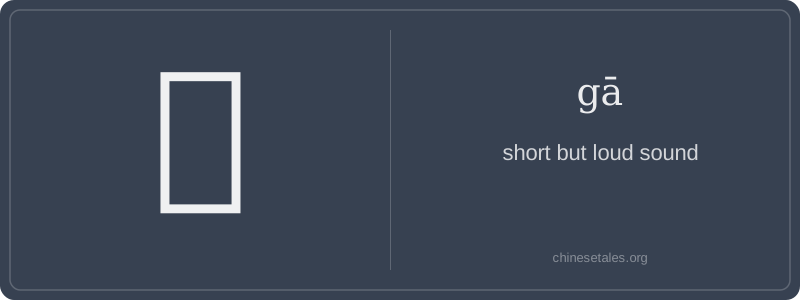
The earliest form of 嘎 isn’t found in oracle bones, but its structure reveals its story: 口 (kǒu, ‘mouth’) on the left — the radical anchoring all speech and sound — and 戈 (gē, ‘dagger-axe’) on the right. Wait — a weapon? Yes! In bronze script, 戈 wasn’t just literal warfare; it symbolized *sharpness*, *cutting force*, and *abrupt termination*. So 嘎 visually fuses ‘mouth’ + ‘sudden edge’ — a perfect glyph for a sound that starts and stops instantly, like a blade slicing air. Over centuries, the 戈 component simplified: the top hook sharpened, the horizontal stroke shortened, and the dot emerged — evolving into today’s clean, angular right-hand side with exactly 14 strokes.
This ‘mouth + sharpness’ logic persisted into classical usage. Though rare in pre-Qin texts, 嘎 gained traction in Ming-Qing vernacular fiction and regional opera scripts where vivid sound effects were prized — think of a storyteller slamming a wooden clapper and shouting ‘Gā!’ to signal a plot twist. Its visual sharpness mirrors its auditory function: no lingering resonance, no vowel glide — just a percussive, glottal stop-like burst. Even today, the character’s rigid, angular strokes echo the very sound it names: abrupt, unadorned, and impossible to ignore.
Imagine a startled goose bursting from reeds at dawn — not a long honk, but a sharp, staccato gā! — like a door hinge suddenly snapping shut. That’s 嘎: not just any sound, but a sudden, brief, high-contrast noise that cuts through silence. It’s onomatopoeic to its core, carrying visceral energy — think the gā of a crow’s alarm call, a squeaky toy, or even a nervous laugh escaping your throat. Unlike generic ‘sound’ words like 声 (shēng), 嘎 is hyper-specific: it’s short, loud, often slightly grating or jarring, and always *unplanned*.
Grammatically, 嘎 works as an interjection (‘Gā!’ — when you drop your phone) or as the final syllable in reduplicated onomatopoeic phrases like 嘎嘎 (gā gā) for repeated goose cries or nervous giggles. Crucially, it’s rarely used alone in formal writing; you’ll hear it spoken, see it in comics, children’s books, or dialect-rich dialogue. Learners sometimes overuse it trying to sound ‘natural,’ but native speakers reserve it for moments of abrupt sonic surprise — using it for gentle rain or a soft knock would feel comically wrong.
Culturally, 嘎 carries rustic charm and folk authenticity — it appears in Northeastern Chinese dialects (like ‘gá’ for ‘stubborn’) and Mongolian loanwords (e.g., 嘎仙洞 Gāxiān Dòng, a legendary cave). Note the alternate pronunciations: gá (in dialects meaning ‘stubborn’ or ‘to grab’) and gǎ (rare, in historical phonetic transcriptions). But for 95% of learners, stick with gā — the goose’s exclamation point.