喽
Character Story & Explanation
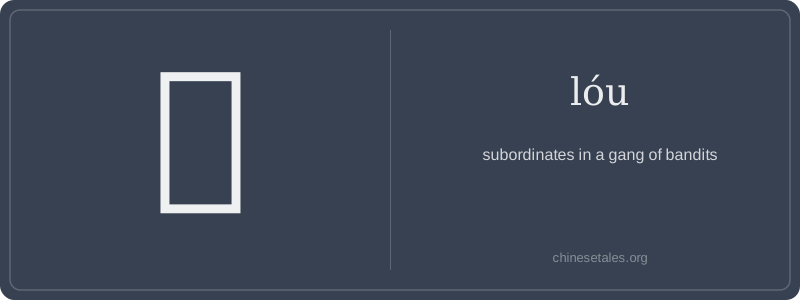
The character 喽 doesn’t appear in oracle bone or bronze inscriptions — it’s a latecomer, born during the Ming-Qing vernacular explosion. Its earliest forms appear in printed editions of outlaw novels like Water Margin, where scribes needed a phonetic-semantic compound to capture the slang term for petty gang members. Visually, it combines 口 (kǒu, 'mouth') on the left — signaling speech, vocalization, or group identity — and 楼 (lóu, 'building, pavilion') on the right, which here serves purely as a phonetic clue (both share the lóu sound). Over centuries, the right side simplified from the full 楼 (13 strokes) to the streamlined version we see today: five strokes forming the top (⺈ + 一 + 丶) and the bottom 木 (mù, 'tree'), now stylized into two parallel horizontal lines above a cross-shaped base.
This visual evolution mirrors its semantic journey: from literal 'people who shout together in the same tower' (a poetic image of bandits rallying on a watchtower) to the modern, tongue-in-cheek 'henchman'. Classical texts avoid it entirely — Confucian scholars wouldn’t dignify foot soldiers with a dedicated character — but folk storytellers embraced it. In the 19th-century novel The Seven Heroes and Five Gallants, 喽啰 appears dozens of times, always paired with descriptors like 小 (xiǎo, 'small') or 虾兵蟹将 (xiā bīng xiè jiàng, 'shrimp soldiers and crab generals') — reinforcing its playful, deprecatory flavor. The mouth radical reminds us these aren’t silent workers — they’re the ones shouting slogans, echoing orders, and making noise as part of the pack.
Think of 喽 (lóu) as the linguistic equivalent of a cartoonish gangster’s henchman — not dangerous on their own, but instantly recognizable by their role: low-ranking, obedient, and often slightly ridiculous. It’s not a neutral word for 'subordinate' like 部下 (bùxià) or 下属 (xiàshǔ); it’s deliberately colloquial, mocking, and steeped in wuxia novels and folk storytelling. You’ll almost never hear it in formal offices or government documents — it belongs in comic banter, satire, or when someone rolls their eyes at a boss’s yes-man.
Grammatically, 喽 is nearly always used as a noun (rarely a verb), and it almost always appears with modifiers: 小喽啰 (xiǎo lóu luó), 大喽啰 (dà lóu luó), or just 喽啰 (lóu luó). Notice the reduplication — that’s key! The standalone character 喽 rarely appears alone; it’s almost always part of the compound 喽啰 (lóu luó), where the second syllable is toneless and functions like a diminutive suffix. Learners sometimes mistakenly write 喽 as a standalone word or confuse it with similar-sounding characters — but remember: if you’re using it, you’re probably poking fun, not filing HR paperwork.
Culturally, this word carries the scent of dusty opera stages and old martial-arts films — think of a mountain bandit camp where the leader barks orders and three identically dressed, wide-eyed underlings shout 'Yes, Chief!' in unison. Misusing it (e.g., calling your coworker a 喽 in a meeting) risks sounding cruel or immature. And crucially: it’s almost always plural in implication — even one 喽啰 suggests 'one of many', not an isolated individual. That collective, almost caricatured quality is baked into its sound and shape.