嘌
Character Story & Explanation
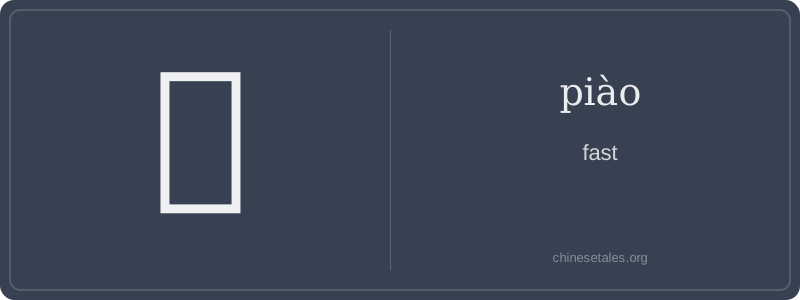
The earliest form of 嘌 appears not in oracle bones but in late Warring States bamboo slips and Han dynasty texts, where it evolved from a phonosemantic compound: 口 (kǒu, 'mouth') + 票 (piào, 'ticket' or 'certificate' — originally 'fluttering banner'). The 口 radical signals speech or sound; the right-hand component 票 (itself composed of 方 + 西 + 漂's water element) contributed both sound and the idea of lightness, swiftness, and sudden movement — like a banner snapping in wind. Over centuries, the top of 票 simplified from 方+西 to a stylized 少-like shape, and the lower part condensed into the modern 嘌’s compact 14-stroke form, preserving the mouth-and-motion duality.
This visual logic mirrors its semantic evolution: from 'a fluttering, snapping sound' (early Han medical texts describing tendon snaps) to 'sudden, sharp motion' (Tang poetry using 嘌然 to depict a startled deer leaping). In the Guwen Guanzhi, it appears in the phrase '嘌然若惊' — 'startled as if snapped awake', linking acoustic sharpness to psychological immediacy. The character never meant abstract 'speed' like 快; rather, it captured the *instantaneous sonic signature* of acceleration — the 'pop' before the blur. That’s why it survives today only in vivid, onomatopoeic set phrases, not as a standalone adjective.
Think of 嘌 (piào) not as a 'fast' you’d slap on a sports car, but as the breathless, almost comical speed of someone shouting 'Hurry up!' while waving their arms — it’s an onomatopoeic burst of urgency, rooted in vocalization, not velocity. Unlike common 'fast' words like 快 (kuài) or 迅速 (xùnsù), 嘌 is rare, literary, and almost exclusively used in fixed idiomatic expressions or classical-style exclamations. It doesn’t modify verbs directly ('he runs 嘌') — instead, it appears in interjections like 嘌地一声 (piào de yī shēng), mimicking the sharp, explosive sound of something snapping, tearing, or bursting into motion.
Grammatically, 嘌 functions almost exclusively as an adverbial morpheme in reduplicated or sound-symbolic phrases: 嘌地 (piào de), 嘌然 (piào rán), or 嘌的一声 (piào de yī shēng). You’ll never say '他跑得嘌' — that’s ungrammatical and would confuse native speakers. Instead, it modifies the *manner* of a sudden auditory or kinetic event: 'The rope broke 嘌的一声.' Its usage is tightly bound to sensory immediacy — like the English 'pop!', 'crack!', or 'whoosh!', but with a distinctly Chinese phonetic flavor.
Culturally, 嘌 is a fossilized echo of Middle Chinese sound symbolism — a character preserved more for poetic texture than daily utility. Learners often mistakenly treat it as a synonym for 快 and try to use it predicatively (e.g., '时间嘌了' — nonsense!). It’s also frequently misread as piāo (like 漂) due to visual similarity, leading to pronunciation blunders. Its rarity means even many native speakers only recognize it from classical poetry or wuxia novels — not textbooks, not HSK, not street signs. It’s the linguistic equivalent of finding a vintage film reel in a streaming app: unexpected, atmospheric, and best appreciated with context.