嘀
Character Story & Explanation
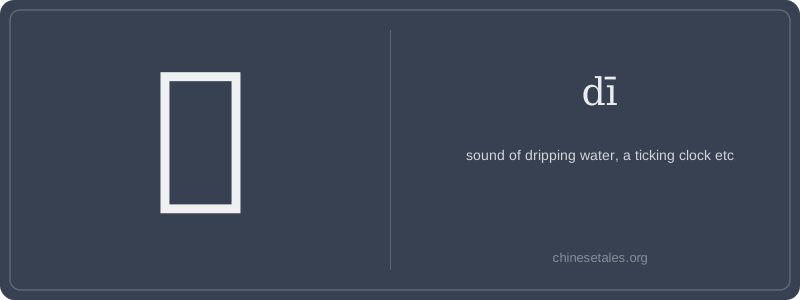
There’s no oracle bone or bronze script for 嘀 — it’s a latecomer, born during the late imperial era (Ming–Qing) as written Chinese expanded to capture everyday sounds. Its structure is brilliantly transparent: left side 口 (kǒu, 'mouth') signals 'sound-related', while the right side 滴 (dī, 'to drip') provides both pronunciation and meaning. Wait — 滴 is itself a compound: 氵(water radical) + 极 (jí, 'extreme') — suggesting water falling to its utmost point, drop by drop. Over centuries, scribes simplified 滴’s right half into the streamlined 'dí' shape we see today in 嘀 — keeping just enough strokes (14 total) to echo the slow, measured fall of liquid.
By the Qing dynasty, 嘀 appeared in vernacular fiction to evoke intimacy and interiority — not just water sounds, but the inner pulse of time and anxiety. In Pu Songling’s *Strange Tales*, a lonely scholar hears 嘀嗒 in an empty study, the sound mirroring his heartbeat. Interestingly, the character’s visual rhythm — the compact 口 anchoring the flowing right side — mirrors its auditory function: a small mouth releasing a steady, repeating pulse. It didn’t exist in classical texts because ancient writers used more abstract terms for time; 嘀 is a modern ear’s gift to the written language — precise, sensory, and quietly urgent.
Think of 嘀 (dī) as Chinese onomatopoeia’s quiet cousin — not the loud 'bang!' or 'woof!', but the soft, insistent *tick-tick-tick* of a clock at 3 a.m., or the *drip… drip…* of a leaky faucet when you’re trying to sleep. It’s not a verb or noun by itself; it’s almost always reduplicated (嘀嘀, dī dī) or paired in sound-mimicking phrases like 嘀嗒 (dī dā) — and crucially, it appears *only* in expressive, sensory contexts, never in formal writing or abstract speech. You’ll hear it in stories, poetry, or descriptive narration — never in a business email.
Grammatically, 嘀 rarely stands alone. It’s nearly always part of a mimetic compound: 嘀嘀 (dī dī) for short, sharp beeps (car horns, text alerts), 嘀嗒 (dī dā) for rhythmic dripping or ticking, or 嘀咕 (dī gu) — wait, that’s different! (More on that confusion later.) Learners often mistakenly use 嘀 as a standalone verb ('to drip'), but no — Chinese doesn’t say 'the faucet 嘀s'; it says '水在嘀嗒响' (shuǐ zài dī dā xiǎng) — 'water is making a dī-dā sound'. The character needs its sonic partner.
Culturally, this character lives in the realm of atmosphere and mood — think of a rainy night scene in a wuxia novel, or the tense silence before a decision, broken only by the 嘀嗒 of a wall clock. A common mistake? Overusing it like English ‘tick-tock’ — but in Chinese, even subtle repetition carries weight. Too many 嘀嘀 in a sentence feels childish or cartoonish. Also, avoid mixing it up with 嘀咕 (dī gu, 'to mutter') — same first character, totally different second, and *completely* different meaning!