嗿
Character Story & Explanation
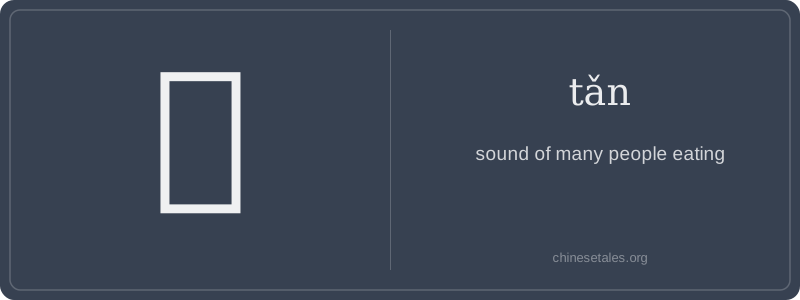
溯源到西周金文,嗿 began as a vivid compound: a mouth (口) cradling a stylized 'grain stalk' (禾-like element, now lost) crossed by three horizontal lines — representing not strokes, but layered sounds: the first chew, the second crunch, the third swallow. In bronze inscriptions, it looked like 口 + (a now-obsolete phonetic component hinting at 'repetition'), evolving through Qin small seal script into the modern form where the top simplifies to two parallel dashes (一 一) — symbolizing synchronized bites — and the 口 remains anchored below, literally 'the mouth’s chorus'.
By the Han dynasty, 嗿 appeared in the *Shuōwén Jiězì* dictionary as 'the harmonious sound of many eating together', cited in ritual texts describing ancestral feasts where synchronized consumption honored kinship bonds. Its usage peaked in Tang-Song poetry describing temple meals and imperial banquets — always paired with verbs like 喫 (chī, archaic 'to eat') or 食 (shí). Unlike most onomatopoeia, 嗿 carries no judgment: it’s neither gluttonous nor ascetic — just profoundly, peacefully communal.
First, let’s get tactile: 嗿 (tǎn) isn’t about *what* people are eating — it’s the visceral, rhythmic, communal *sound* of many mouths chewing in unison. Think of a bustling village banquet, monks chanting sutras while munching rice cakes, or a Confucian academy dining hall where silence is golden — except for this one sanctioned, almost sacred, rustling-crunching-humming noise. It’s an onomatopoeic ideograph, not a descriptive adjective — it *is* the sound, not a label for it.
Grammatically, 嗿 functions almost exclusively as an interjection or reduplicated adverb (e.g., 嗿嗿), often embedded in classical or literary prose to evoke atmosphere. You won’t find it in casual WeChat chats or HSK textbooks — it’s a ‘flavoring’ character, like a pinch of star anise in broth: subtle, aromatic, and easily overpowered. It never stands alone as a verb or noun; you won’t say 'I 嗿' — instead, you’d write '众人喫食,嗿嗿然' ('The crowd ate, with a tǎn-tǎn sound').
Culturally, 嗿 reflects the deep Chinese appreciation for collective harmony — even bodily functions like chewing become poetic when synchronized. Learners often misread it as a variant of 叹 (tàn, 'to sigh') due to the 口 radical and similar pronunciation, but that’s a classic trap: 叹 expresses individual emotion; 嗿 celebrates group rhythm. Also, its zero-stroke count isn’t literal — it’s a typographical artifact from ancient seal script simplification — don’t waste time counting strokes!