嗾
Character Story & Explanation
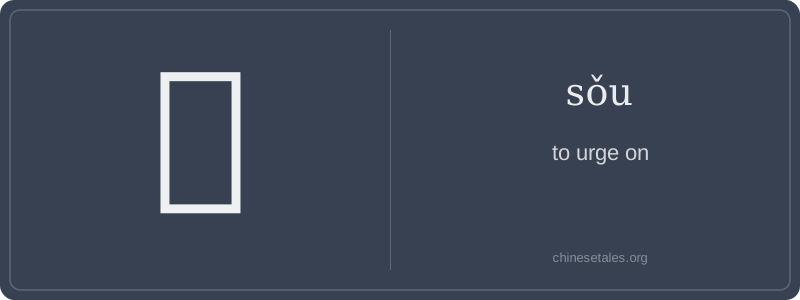
The earliest form of 嗾 appears in bronze inscriptions of the late Zhou dynasty, where it combined 口 (mouth, speech) with 族 (zú, originally depicting a banner with arrows — symbolizing a clan or group mobilized for action). Over centuries, 族 simplified and rotated, its arrow-like elements morphing into the right-hand component we see today: the top part evolved into 宀 (roof, here stylized), the middle became 丶 (dot), and the lower strokes hardened into the distinctive 㐄 shape — resembling a hand gripping a whip or a command staff. By the Han dynasty, the structure had stabilized into its modern 14-stroke form: 口 on the left (emphasizing vocal instigation), and the right side conveying directed, collective action.
This visual evolution mirrors its semantic journey: from literal 'mobilizing a clan via proclamation' to figurative 'urging someone toward harmful or unlawful behavior'. Classical usage appears in texts like the Zuo Zhuan, where lords are accused of 嗾犬噬人 — 'inciting dogs to bite people' — both literally (as punishment) and metaphorically (as political sabotage). Even today, the image persists: 嗾 doesn’t whisper — it barks orders that set dangerous things in motion.
Think of 嗾 (sǒu) as the linguistic equivalent of snapping your fingers to rile up a dog — it’s all about sharp, deliberate incitement. The character carries a distinctly negative or manipulative connotation: you don’t ‘encourage’ with 嗾, you *provoke*, *egregiously urge*, or *stir up trouble*. It’s rarely used for wholesome motivation — more often for goading someone into rash action, deception, or conflict. Grammatically, it’s a transitive verb that almost always takes a human or animal subject and an object being urged (e.g., 嗾使他人作伪证 — 'incite others to give false testimony'). You’ll almost never see it in casual speech; it lives in formal writing, legal contexts, or biting literary critique.
Crucially, 嗾 is nearly always paired with other verbs — especially 使 (to cause/make), forming the compound 嗾使 (sǒu shǐ), which functions like a single lexical unit meaning 'to instigate' or 'to incite'. Learners sometimes mistakenly use it like 劝 (to advise) or 鼓励 (to encourage), but doing so sounds jarringly sinister — imagine saying 'I 嗾 you to study harder' and accidentally implying you’re manipulating them into cheating. Also, note its tone: sǒu is third tone, and mispronouncing it as sōu or sòu breaks the word entirely — no native speaker would recognize it.
Culturally, 嗾 evokes moral condemnation. In classical texts and modern editorials alike, it signals culpability: the person who 嗾 isn’t just suggesting — they’re pulling strings behind the scenes. That’s why you’ll find it in headlines like '官员唆使村民围堵政府' ('Officials incited villagers to blockade the government office') — the character itself carries judicial gravity. And yes, it’s absent from HSK because it’s too specialized and charged for beginner-to-intermediate learners; encountering it usually means you’ve entered the realm of serious news or legal Chinese.