嗷
Character Story & Explanation
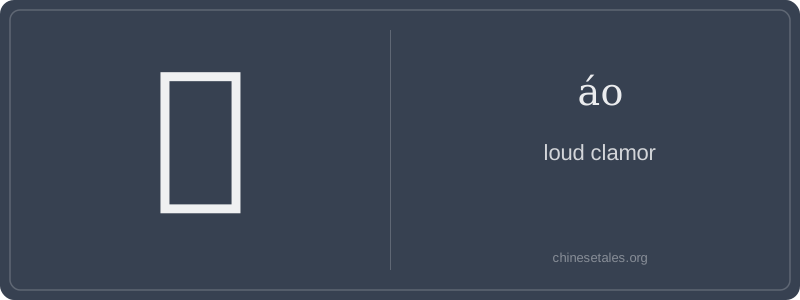
The earliest form of 嗷 appears in late Warring States bamboo texts and Han dynasty seals — not as a pictograph, but as a *phonosemantic compound* born from urgency. The left side 口 (kǒu, ‘mouth’) is straightforward: this is about vocalization. The right side 敖 (áo, originally meaning ‘to wander freely’ or ‘to be unruly’) was chosen not for its meaning but for its sound — yet ironically, its semantic baggage stuck. 敖’s bronze script depicted a person dancing wildly with outstretched arms, evoking unrestrained motion — a perfect visual echo for uncontrolled sound. Over centuries, the 敖 component simplified: the top ‘士’ became ‘士’, the middle ‘方’ condensed, and the bottom ‘攵’ (strike) sharpened into the modern four-dot ‘攵’.
This fusion wasn’t accidental — classical texts like the Shuōwén Jiězì (121 CE) classified 嗷 under 口, noting it represented ‘the sound of beasts crying in distress’. By the Tang dynasty, poets used it metaphorically: Li Bai wrote of ‘孤猿嗷夜月’ (‘a lone ape wails under the night moon’), linking human sorrow to animal cry. The character’s evolution mirrors its meaning: what began as a precise phonetic borrowing gained emotional heft through literary repetition. Its visual tension — rigid mouth radical anchoring the wild, sprawling 敖 — makes it a silent scream on the page.
嗷 (áo) is the sound of raw, unfiltered vocal explosion — think a wolf howling at the moon, a toddler mid-tantrum, or a stadium roaring in unison. It’s not just 'loud'; it’s visceral, emotional, and often involuntary. This character belongs to the expressive onomatopoeic family (like 咚 dōng for a thud or 嘶 sī for a hiss), but with a distinctly *human-animal hybrid* energy: it captures cries that blur the line between speech and instinct.
Grammatically, 嗷 functions almost exclusively as an interjection or verb complement — never as a standalone noun or adjective. You’ll hear it in exclamations (‘嗷——!’) or paired with verbs like 叫 (jiào, to shout) or 啼 (tí, to cry): ‘嗷叫’ (áo jiào), ‘嗷啼’ (áo tí). Crucially, it’s rarely used alone in formal writing; instead, it thrives in vivid narration, children’s literature, or online slang where exaggeration is welcome (e.g., ‘疼得嗷嗷叫’ — ‘hurting so much you’re yelping’). Learners often mistakenly treat it as a noun meaning ‘a cry’ — but no: it *is* the cry, not the thing being cried.
Culturally, 嗷 carries playful, slightly cartoonish weight — it’s the ‘WAAAAH!’ of Chinese comics, the sound effect behind slapstick or dramatic irony. Unlike more restrained expressions (e.g., 啊 ā), 嗷 implies loss of control, intensity, or even absurdity. A common pitfall? Using it in polite conversation — imagine yelling ‘嗷!’ during a business meeting. It’s reserved for storytelling, performance, or affectionate teasing (e.g., mimicking a friend’s overreaction). Its absence from HSK reflects its niche: not essential for daily function, but unforgettable once you hear it roar.