嗵
Character Story & Explanation
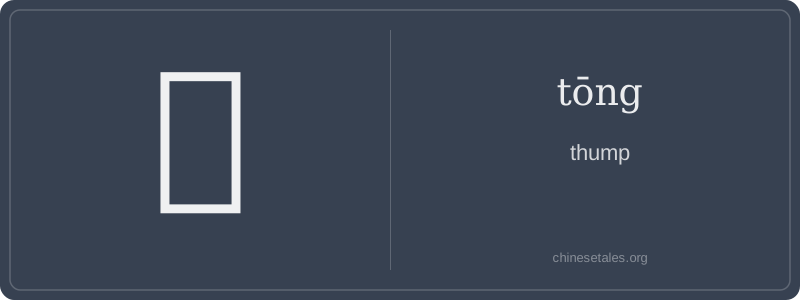
The earliest form of 嗵 doesn’t appear in oracle bones — it’s a relatively late invention, born in the Ming–Qing vernacular literary explosion. Its structure is brilliantly transparent: left side 口 (kǒu, 'mouth') signals it’s a sound-related character; right side 通 (tōng, 'to pass through', 'unimpeded') provides both pronunciation (tōng) and a subtle hint of *forceful transmission*. Visually, the 13 strokes map neatly: the three-stroke 口 on the left, then the nine-stroke 通 — itself composed of 辶 (chuò, 'walking') + 勹 (bāo, 'to wrap') + 廴 (yǐn, 'to extend') — though by the Song dynasty, 通 had already simplified into its modern shape, and scribes appended it to 口 to create this vivid sonic compound.
Its meaning crystallized in vernacular fiction like *The Scholars* (Rulin waishi) and Qing-era operas, where writers needed punchy, rhythmic sound effects for stage directions and comedic timing. Unlike ancient onomatopoeia like 咚 (dōng) — associated with drums and solemnity — 嗵 carries a slightly heavier, earthier, more abrupt quality: less ceremonial gong, more dropped watermelon. The visual weight of 通 (itself meaning 'unblocked flow') ironically contrasts with the sudden *stop* of impact — making 嗵 a linguistic oxymoron: the sound of forceful arrival *through* space, ending in finality. That tension — movement collapsing into moment — is why it still feels so satisfying to say aloud.
Think of 嗵 (tōng) as Chinese onomatopoeia’s answer to the cartoon 'THWUMP!' — not a word you’d find in formal reports or HSK exams, but one that leaps off the page in novels, comics, and animated dialogue. It’s the visceral, gut-level *thump*: the sound of a sack of rice hitting the floor, a fist landing on a drum, or your heart skipping when you see your crush. Unlike English ‘thump’, which can be both noun and verb, 嗵 is almost always used as an interjection or adverbial modifier — it rarely stands alone and nearly always appears with verbs like 掉 (diào, 'to fall'), 落 (luò, 'to land'), or 摔 (shuāi, 'to fall/flop'). You’ll hear it in phrases like 嗵的一声 (tōng de yī shēng) — literally 'a *tōng* sound' — functioning much like 'KER-THUMP!' in English comic books.
Grammatically, it’s a classic ‘sound-word’ (拟声词), and learners often overuse it or misplace it — trying to say 'He thumped the door' as *Tā tōng le mén*, which sounds jarringly childish or ungrammatical. Instead, native speakers embed it: 他‘嗵’地一脚踹开门 (Tā ‘tōng’ de yī jiǎo chuài kāi mén — 'He kicked the door open with a THUMP!'). Notice how 嗵 is wrapped in quotation marks and followed by the structural particle 地 — signaling it modifies the action, not naming it.
Culturally, 嗵 belongs to the joyful, expressive world of colloquial Mandarin — the kind you hear in street storytelling, slapstick TV, or middle-school essays describing dramatic entrances. It’s absent from formal writing not because it’s ‘wrong’, but because it’s *too alive*: too physical, too immediate. A common mistake? Confusing it with similar-sounding 叨 (dāo, 'to chatter') or 通 (tōng, 'through/connected') — which share the same radical but zero semantic overlap. Remember: 嗵 is all about *impact*, not information or connection.