嗲
Character Story & Explanation
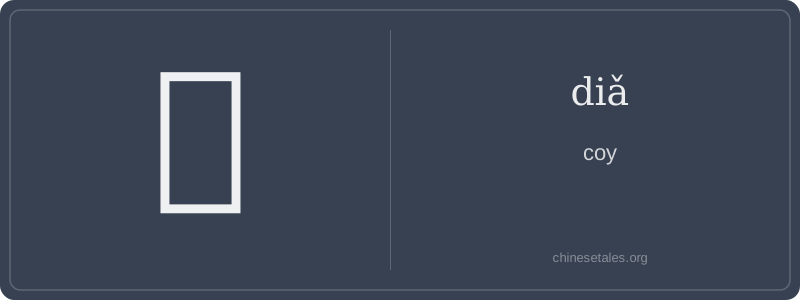
The earliest trace of 嗲 appears not in oracle bones, but in late Qing dynasty vernacular texts — meaning it’s a relatively young character, born from spoken language rather than ancient script. Its shape is transparently constructed: left side 口 (kǒu, 'mouth') signals it’s speech-related; right side 典 (diǎn, 'ceremony, classic') provides the sound (diǎn → diǎ via tone shift and dialect influence). But here’s the twist: 典 wasn’t chosen for meaning — it was borrowed purely for its phonetic resonance in Wu dialects, where 'diǎ' sounded like a drawn-out, melodic utterance. Visually, the 13 strokes layer mouth + ritual gravity — as if turning a solemn chant into a flirtatious trill.
By the 1920s–30s, 嗲 surged in Shanghai novels and film scripts, capturing the city’s cosmopolitan, fast-talking, emotionally expressive urban identity. Writers like Eileen Chang used it to sketch characters who wielded softness as social strategy. Interestingly, classical texts never used 嗲 — it has zero presence in Confucian canon or Tang poetry. Its entire life exists in the realm of modern oral performance: the giggle behind a fan, the sigh before a request, the vocal ‘wiggle’ that says, 'I’m not demanding — I’m inviting you to indulge me.' The mouth + ceremony combo thus becomes deliciously ironic: it’s not ritual — it’s the gentle sabotage of ritual seriousness.
At its heart, 嗲 (diǎ) is the sound of a voice tilting upward like a question — but not a real question. It’s that breathy, high-pitched, deliberately soft tone people use to flirt, plead, or charm: think 'aww, you *know* I can’t resist!' in English — but baked into one Chinese syllable. It’s not just 'cute' or 'shy'; it’s performative tenderness, often with playful irony. Native speakers instantly recognize the vocal register and facial expression that go with it — slightly pouted lips, widened eyes, maybe a little head tilt.
Grammatically, 嗲 functions almost exclusively as an adjective or verb modifier, rarely standing alone. You’ll hear it in reduplicated form (嗲嗲地) describing *how* someone speaks or acts: 'She said it 嗲嗲地' — like saying 'she cooed it'. It’s also common in colloquial phrases like '好嗲啊!' (so coy!), where it behaves like an interjectional adjective. Crucially, it’s almost never used in formal writing or neutral speech — deploying it at a business meeting would land like a glitter bomb in a boardroom.
Culturally, 嗲 carries subtle gendered and regional weight: it’s strongly associated with Shanghai and southern Wu-speaking areas (where it originated), and while anyone can use it, it’s most stereotypically linked to young women’s expressive speech. Learners often misapply it as a generic 'cute' — but 嗲 isn’t about appearance; it’s about *vocal affectation*. Using it to describe a puppy or a cartoon character feels off — it’s human, intentional, and socially calibrated. And yes, it’s so informal that even many native speakers avoid it in text messages unless joking with close friends.