嗬
Character Story & Explanation
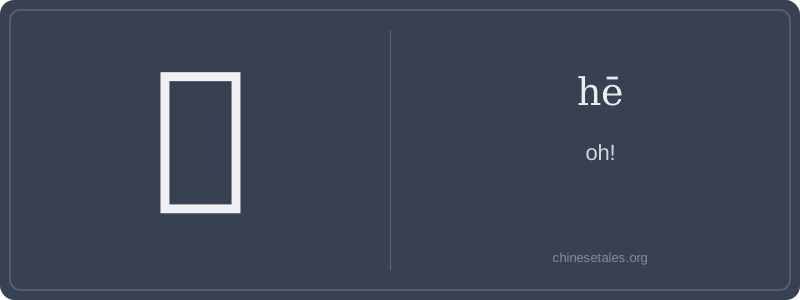
The earliest trace of 嗬 isn’t in oracle bones — it’s a latecomer, born during the late Ming to early Qing dynasties as vernacular fiction exploded. Its form is brilliantly literal: left side 口 (mouth), right side 侯 (hóu, 'marquis' — but here serving purely phonetic duty). Yet look closer: the 口 is wide-open, and the 侯 component contains 亻 (person) + (a fortified wall or raised platform) + 一 + 口 — suggesting someone standing tall, mouth agape, projecting sound outward. Over centuries, clerical script simplified the 侯’s intricate strokes into today’s clean 13-stroke structure, preserving both the oral gesture and the resonant ‘hē’ sound.
Originally, 嗬 appeared in novels like Water Margin and Strange Tales from a Chinese Studio, where it punctuated moments of awe, shock, or ironic realization — never mere surprise, but *recognition with weight*. When a scholar sees a ghostly ink painting move, he doesn’t say ‘ā!’ — he says ‘嗬!’: a vocalized pause before meaning dawns. The character’s visual weight (13 strokes!) mirrors its semantic heft: it’s not filler noise — it’s the sonic equivalent of stepping back, inhaling sharply, and letting reality hit you all at once.
Think of 嗬 as Chinese onomatopoeia’s theatrical gasp — not a polite 'oh', but the kind you’d blurt out when spotting a giant spider on your keyboard or seeing your coffee order handed to the wrong person: a sharp, breathy, slightly startled exclamation that vibrates in your throat. It’s not a word you conjugate or decline — it’s pure vocal punctuation, always standing alone (or at sentence start), never modifying nouns or verbs. You’ll never see 嗬 + 的 or 嗬 + 了. It lives exclusively in spoken-style writing: comics, novels, dialogue-heavy scripts, and social media captions where tone and reaction matter more than grammar.
Grammatically, it’s a discourse particle — like English ‘whoa!’ or ‘jeez!’, but with distinctly Mandarin rhythm and mouth shape. Note the initial ‘h-’ and open ‘ē’ vowel: your mouth starts wide (like yawning) and releases air quickly — exactly what the 口 radical signals. Learners often misread it as ‘hè’ (like 贺) or overpronounce the second syllable; remember: it’s one syllable, one breath, one burst — hē, not heh or hee. And crucially: it’s *not* interchangeable with 啊 (ā), 哎 (āi), or 哦 (ò). Those convey softer, more drawn-out reactions; 嗬 is sudden, physical, almost visceral.
Culturally, 嗬 carries subtle performative flair — it appears frequently in wuxia novels when a hero glimpses an ancient sword, or in satirical essays mocking bureaucratic absurdity. It’s rarely used in formal speech or academic writing (hence its absence from HSK), but instantly recognizable to native readers as a marker of vivid, embodied response. A common mistake? Trying to use it in polite conversation — it’s too raw for customer service or emails. Save it for texts to friends, dramatic monologues, or captioning your own shocked face emoji.