嗥
Character Story & Explanation
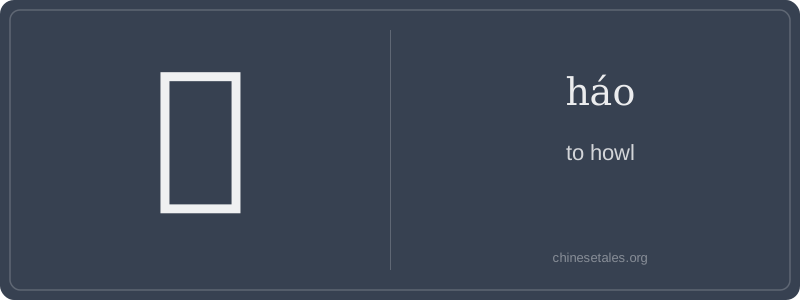
The earliest form of 嗥 appears in late Warring States bamboo texts — not oracle bone, but already highly stylized. Its left side, 口 (kǒu, 'mouth'), anchors the character visually and semantically, signaling vocal action. The right side, 皋 (gāo), was originally a phonetic component borrowed from a word meaning 'marshy highland', but its shape — three horizontal strokes above a 'ten' (十) and 'enclosure' (冂-like structure) — evokes layered resonance: breath rising, vibrating, echoing across open space. Over centuries, the top of 皋 simplified from ⺈+白+十 to today’s streamlined 亠+口+十, preserving the sense of upward projection and sustained sound.
By the Han dynasty, 嗥 had crystallized as the go-to verb for long, mournful, or defiant vocalization — notably in poetry like Cao Cao’s ‘Short Song Style’, where it describes ghosts 嗥 in empty tombs. Its visual rhythm mirrors its sound: the compact 口 at left feels like lips parting; the tall, rising 皋 suggests the voice climbing in pitch and volume. Classical writers loved pairing it with 风 (fēng, 'wind') or 月 (yuè, 'moon') to amplify loneliness or grandeur — a linguistic echo chamber where meaning and form howl in unison.
Think of 嗥 (háo) as Chinese’s answer to the wolf howl in a Hollywood horror soundtrack — not just sound, but raw, untamed emotion bursting from the throat. It’s not polite speech or quiet sighing; it’s visceral, often animalistic vocalization: wolves howling at the moon, dogs baying in distress, or even humans screaming in anguish or ecstasy. Unlike English ‘howl’, which can be transitive (‘He howled with laughter’) or intransitive (‘The wind howled’), 嗥 is almost always intransitive and strongly tied to intensity — you wouldn’t 嗥 over spilled milk, but you might 嗥 when your team wins the championship after 30 years.
Grammatically, 嗥 behaves like most Chinese verbs: no conjugation, no tense markers. Context provides time — past, present, or future. It pairs naturally with onomatopoeic reduplication (e.g., 嗥——! for a sharp, sudden howl) or adverbial phrases like 悲愤地 (bēi fèn de, 'in grief and fury'). Learners often mistakenly use it where they’d say ‘shout’ or ‘cry’ in English — but 嗥 implies *uncontrolled*, *resonant*, *pitched* vocalization — think operatic wail, not office complaint.
Culturally, 嗥 carries literary weight: it evokes classical imagery of desolation (wolves in barren mountains) or righteous rage (a wronged hero roaring at injustice). Modern usage is rare in daily speech — mostly reserved for poetic, dramatic, or satirical contexts. A common mistake? Using it like 叫 (jiào, 'to call/shout') — but while 叫 is neutral and functional, 嗥 is theatrical, primal, and slightly archaic. You’ll find it more in novels than in WeChat chats.