嗤
Character Story & Explanation
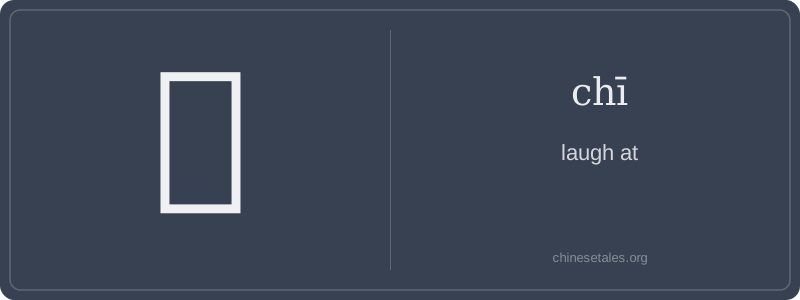
The earliest form of 嗤 appears in Warring States bamboo slips as 口 + 斥 — not a pictograph, but a semantic-phonetic compound. The left side 口 (kǒu) signals speech or sound; the right side 斥 (chì) originally depicted a hand pushing away — a gesture of rejection — and provided both meaning (‘to repel’) and sound (chì → chī, tone shift over centuries). Over time, 斥 simplified slightly: its top dot fused into the horizontal stroke, and the lower ‘foot’ radical evolved into the modern three-stroke ‘displaced’ shape under the crossbar — giving us today’s 13-stroke 嗤.
This visual logic held firm: mouth + repulsion = vocal dismissal. In the Zhuangzi (c. 3rd century BCE), 嗤 appears in dialogues where sages mock rigid moralists — not with anger, but with a soft, knowing snort that questions dogma itself. By the Tang dynasty, poets like Du Fu used 嗤 to convey ironic detachment, cementing its role as the ‘intellectual’s scoff’. Its sound — chī — even mimics the sharp, airy expulsion of breath, making it a rare example of onomatopoeic precision in Chinese script.
Imagine you’re at a Ming dynasty poetry gathering, and a pompous scholar recites a flowery, overwrought verse — only for an old master to let out a single, sharp chī! through his nose, eyes crinkling with dry, unimpressed amusement. That sound — not laughter, not scorn, but a quiet, dismissive exhalation of contempt — is the soul of 嗤. It’s not loud mockery like 嘲笑 (cháoxiào), nor gentle teasing like 调侃 (tiǎokǎn); it’s the verbal equivalent of raising one eyebrow while slowly folding your arms.
Grammatically, 嗤 is almost always used in compound verbs or literary set phrases: 嗤之以鼻 (chī zhī yǐ bí — 'to snort at something with one’s nose'), 嗤笑 (chīxiào — 'to sneer-laugh'), or as a standalone verb in formal writing ('他嗤了一声' — tā chī le yī shēng — 'He gave a derisive snort'). You’ll rarely hear it in casual speech — native speakers reach for 哼 (hng) or 算了 (suànle) instead. Learners often mistakenly use it as a transitive verb without a complement (e.g., *他嗤你), but it requires either a direct object + particle (嗤之) or a full phrase like 嗤之以鼻.
Culturally, 嗤 carries Confucian-tinged restraint: it’s disdain delivered with elegance, not rage. Mistake it for casual sarcasm, and you’ll sound oddly archaic — like quoting Zhuangzi at a coffee shop. Also, avoid using it with people senior to you: that ‘snort’ may land as insolence, not wit.