嗣
Character Story & Explanation
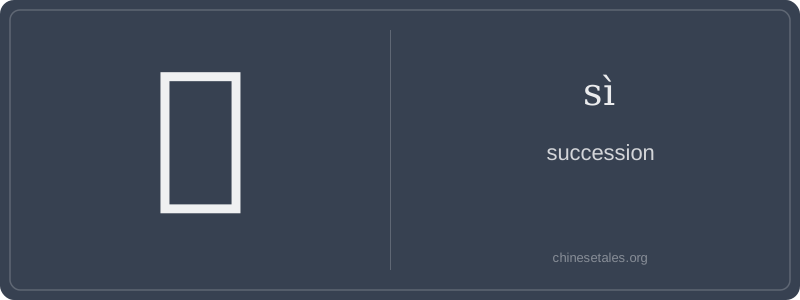
The earliest form of 嗣 appears in bronze inscriptions (c. 1000 BCE) as a complex pictograph: a kneeling figure (later simplified to the top 巳 component) beside a mouth (口), with an additional stroke representing a ritual vessel or offering. Over centuries, the kneeling figure evolved into 巳 (sì, an ancient character meaning 'completed cycle'), while the mouth remained — signaling that succession wasn’t just biological, but ritually *declared*. By the Han dynasty, the structure stabilized into today’s 13-stroke form: 巳 (top) + 口 (bottom left) + another 巳-like element fused into the right side (now written as the lower-right strokes resembling + 丨). Visually, it’s two 'completed cycles' framing a mouth — a powerful image of cyclical renewal announced.
This visual duality reflects its semantic journey: from early meanings like 'to announce completion of rites' to 'to formally assume office after death of predecessor'. In the *Zuo Zhuan*, it describes dukes succeeding fathers without dispute; in Tang legal codes, 嗣子 meant the legally recognized heir entitled to ancestral land and sacrifices. Even today, Buddhist temples use 嗣法 (sì fǎ) for 'transmission of Dharma' — echoing that ancient idea: true succession requires both lineage and public affirmation.
Think of 嗣 (sì) as the quiet, dignified heir — not the flashy crown prince, but the one formally designated to carry forward a lineage, title, or sacred duty. Its core meaning is 'succession' in the most solemn sense: passing down authority, inheritance, or ritual responsibility across generations. It’s not about casual continuity (like 'continuing a habit'), but about legitimacy, authorization, and unbroken transmission — especially in imperial, familial, or religious contexts. You’ll rarely hear it in daily speech; it lives in classical texts, legal documents, and formal announcements.
Grammatically, 嗣 functions mainly as a verb ('to succeed') or as part of compound nouns like 嗣子 (sì zǐ, 'heir') or 嗣位 (sì wèi, 'to ascend the throne'). It almost never stands alone in modern usage — you won’t say *‘I sì’* like ‘I eat’. Instead, it appears in tightly bound phrases: 嗣承 (sì chéng, 'to inherit and continue'), 嗣立 (sì lì, 'to appoint as successor'). Watch out: learners sometimes overuse it trying to sound formal, but native speakers prefer 继承 (jì chéng) for general 'inheritance' — 嗣 carries heavier historical and ceremonial weight.
Culturally, 嗣 is steeped in Confucian kinship ethics and imperial protocol. Mistaking it for a generic synonym of 'continue' misses its gravity: in ancient China, failing to produce a 嗣 could jeopardize ancestral rites and family survival. Also, don’t confuse its pronunciation — sì rhymes with 'see', not 'sir' — and note that its 口 (mouth) radical isn’t about speaking, but about ritual proclamation: succession was declared aloud, witnessed, and affirmed through words.