嗟
Character Story & Explanation
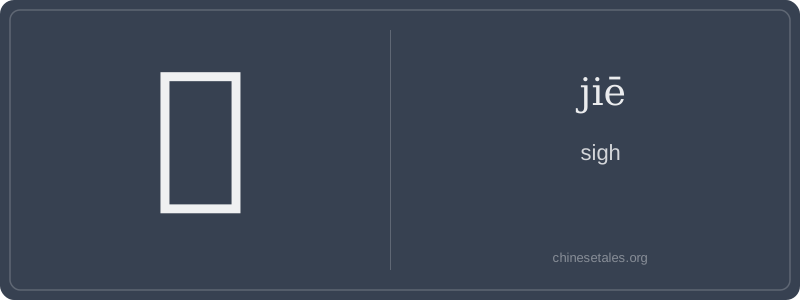
The earliest form of 嗟 appears in Warring States bamboo slips, not oracle bones — and it’s a masterclass in phonosemantic fusion. Left side 口 (kǒu, 'mouth') signals vocalization; right side 差 (chā/chà, 'to differ', 'uneven') was borrowed *for its sound*, not meaning. In ancient pronunciation, 差 ended in -a (like 'ah'), matching the drawn-out, open-mouthed exhalation of a sigh. Over centuries, the 差 component simplified: its top radical (羊 yáng, 'sheep') shrank to ⺶, and the bottom (工 gōng, 'work') became 巴 — giving us today’s elegant 12-stroke structure: mouth + 'a' sound.
This character didn’t evolve from a picture of sighing — it was *designed* as a sonic symbol. By the Han dynasty, it was already entrenched in ritual odes and funerary inscriptions. Qu Yuan’s Lament for Ying opens with 嗟!— a single syllable that suspends time, demanding silence before grief unfolds. Even today, calligraphers linger on its final stroke: the downward hook of 巴 mimics the droop of shoulders after exhaling sorrow. It’s not just how you say it — it’s how your body leans into the sound.
Think of 嗟 (jiē) as the literary, dramatic sigh — not the casual 'ugh' you mutter while scrolling, but the kind that rises from your diaphragm in classical poetry or a solemn monologue. It’s an interjection, always standing alone or at the start of a sentence, carrying weight, regret, awe, or lament. Unlike everyday words like 啊 (ā) or 哎 (āi), 嗟 is formal, archaic, and emotionally charged: it’s the sound of a sage pausing before delivering wisdom, or a poet gazing at autumn leaves. You’ll almost never hear it in spoken Mandarin today — it lives in texts, opera, and stylized speech.
Grammatically, 嗟 functions like an exclamatory particle with no verb or object attached — it doesn’t conjugate, take objects, or appear mid-sentence. It’s always sentence-initial and followed by a pause (often marked by , or — in writing). Misusing it as a verb ('to sigh') or attaching it to a noun ('sigh of sorrow') is a classic learner error — 嗟 isn’t a noun or verb; it *is* the sigh itself, frozen in ink. In classical texts, it frequently opens laments: 嗟乎!(jiē hū!) — 'Alas!' — where the 'hū' adds rhetorical flourish, like adding 'indeed!' to 'Alas!'
Culturally, 嗟 carries Confucian gravity and poetic restraint. It appears over 20 times in the Classic of Poetry (Shījīng), often marking shifts in emotional tone or moral reflection. Modern learners mistakenly insert it into casual speech thinking it sounds 'authentically Chinese' — but native speakers would blink, then gently suggest 啧 (zé) for mild disapproval or 唉 (āi) for everyday sighing. Its rarity makes it precious — like finding a Tang-dynasty coin in your dumpling.