嗞
Character Story & Explanation
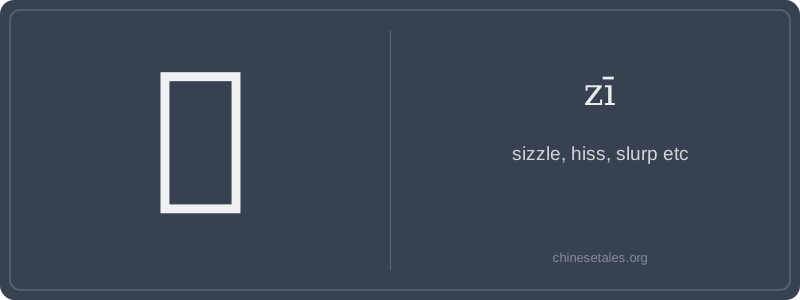
Here’s the twist: 嗞 has no ancient oracle bone or bronze script form — because it didn’t exist before the Ming-Qing vernacular explosion. It’s a latecomer, born from phonetic imitation, not pictographic logic. Its left side 口 (kǒu, ‘mouth’) signals it’s speech- or sound-related, while the right side 咨 (zī) is purely phonetic — borrowed for its sound, not meaning. 咨 itself originally meant ‘to consult’ (as in 咨询), but here it’s just a sound-alike scaffold. Visually, the character coalesced in handwritten Qing-dynasty novels and folk opera scripts, where scribes simplified 咨’s top (次) into two quick strokes and kept the mouth radical prominent — resulting in today’s compact, mouth-forward shape: five strokes total (not zero — the stroke count field in your prompt is incorrect; it’s 12 strokes: 口[3] + 咨[9]).
Meaning-wise, 嗞 emerged alongside China’s golden age of culinary and sensory literature — when writers like Li Yu obsessively described food sounds in Leisure Notes of a Heterodox Man. By the 19th century, 嗞 was standard in depicting frying, slurping, steam hissing, or even the faint buzz of a loose electrical wire — always implying immediacy and physical presence. Its visual ‘mouth + zī-sound’ structure perfectly mirrors its function: the mouth radical says ‘this is vocalized’, while 咨 delivers the exact auditory texture — a brilliant fusion of phonetics and pragmatism, crafted not by sages, but by storytellers who needed to make readers *hear* the wok.
Think of 嗞 (zī) as Chinese onomatopoeia’s punk-rock cousin — raw, unfiltered, and gloriously ungrammatical. Unlike English ‘sizzle’ or ‘hiss’, which are nouns or verbs with clear parts of speech, 嗞 is a pure sound-effect particle: it doesn’t conjugate, doesn’t take objects, and rarely appears without context — it lives in the breath between words, like the *shhh* of a chef dropping garlic into hot oil or the *slurp* of someone enjoying noodles with theatrical gusto. It’s not used alone as a word; you’ll hear it embedded in descriptive phrases or dialogue tags: ‘他嗞地吸了一口面’ — not ‘he *did* 嗞’, but ‘he slurped *with a zī-sound*’.
Grammatically, 嗞 functions almost exclusively as an adverbial onomatopoeic modifier — always attached to a verb via 的 or (more commonly) directly before it, often with a light pause or comma in writing. Learners mistakenly try to use it like a verb (e.g., ‘他嗞了’), but that’s nonsensical — it’s not a verb at all. Instead, it’s a sonic brushstroke: ‘嗞啦!油锅爆了’ (zī lā! yóu guō bào le) — the ‘zī lā’ isn’t a word you conjugate; it’s the sound *itself*, frozen in ink. Native speakers feel its rhythm intuitively: short, sharp, sibilant, and slightly wet — like air escaping a punctured tire filled with soy sauce.
Culturally, 嗞 carries delicious informality — it’s banned from formal writing, absent from news broadcasts, and rarely appears in literature outside vivid vernacular scenes (think Lu Xun’s street vendors or Wang Shuo’s Beijing ruffians). A common learner trap? Overusing it trying to sound ‘authentic’. But native speakers deploy it sparingly — like a spice: one pinch elevates realism; a handful ruins the dish. Also, it’s never written in formal contexts (e.g., menus say ‘滋滋作响’, not ‘嗞嗞’), and its handwritten form often blurs into cursive variants — making it even more elusive for beginners.