嗝
Character Story & Explanation
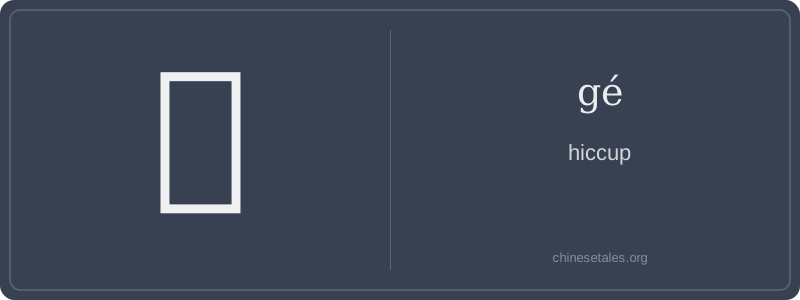
The earliest trace of 嗝 lies not in oracle bones—but in its components. It’s a phono-semantic compound (形声字) created during the Han dynasty or later: the left radical 口 (kǒu, ‘mouth’) signals its connection to vocalized bodily sounds, while the right side 葛 (gé, originally a plant name, later a surname) provides the pronunciation clue. Visually, the modern form preserves this balance: three strokes for 口 (vertical, horizontal折, closing hook), then ten strokes for 葛—its top 艹 (grass radical) evolving from ancient pictographs of intertwined vines, and its bottom 葛’s lower part (曷) representing a person with arms raised, possibly echoing the gasping motion of a hiccup. Stroke order matters: begin with 口, then meticulously build 葛—no shortcuts, or the ‘hiccup’ loses its breath!
Historically, 嗝 didn’t appear in classical texts like the *Shuōwén Jiězì*—it emerged organically in vernacular speech as Mandarin phonology stabilized around the Ming–Qing transition. Its rise mirrors the broader trend of onomatopoeic mouth-radical characters (like 咳 *ké*, ‘cough’, or 啊 *ā*, ‘ah!’) filling lexical gaps for spontaneous, embodied expressions. Unlike literary terms for illness (e.g., 疾 *jí* or 病 *bìng*), 嗝 carries zero pathology—it’s purely phenomenological, capturing the *sound* and *sensation*, not the cause. That’s why it feels so alive today: it’s not a relic, but a living echo of how Chinese speakers name the tiny, universal stutters of being human.
Imagine your friend Leo just scarfed down a bowl of spicy dan dan noodles, then suddenly—gék!—a loud, involuntary hiccup bursts out. Everyone at the table laughs, and someone says, 'Hǎo xiàng tā chī tài kuài le, yí gè jiē yí gè de gé!' (He must’ve eaten too fast—hiccups one after another!). That gé isn’t just sound—it’s the character 嗝: the onomatopoeic, bodily, slightly undignified but utterly human word for hiccup. It’s not abstract or medical; it’s visceral, colloquial, and always spoken aloud with a little breathy puff.
Grammatically, 嗝 functions almost exclusively as a noun or interjection—not a verb. You don’t ‘do’ a hiccup; you *have* a 嗝, *get* a 嗝, or *let out* a 嗝. You’ll hear it in reduplication (gé gé) for repeated hiccups, or with measure words like ‘yí gè’ (one hiccup) or ‘liǎng shēng’ (two sounds). Crucially, it’s never used in formal writing or speech—you won’t find it in news reports or business emails. Learners sometimes mistakenly try to use it as a verb (e.g., *wǒ gé le*), but native speakers say *wǒ dǎ le yí gè gé* (I let out a hiccup) or simply *wǒ gé gé gé!* as an expressive exclamation.
Culturally, hiccups are seen as harmless, even endearing—especially in kids or after meals. There’s no stigma, just gentle teasing or home remedies (like holding your breath or drinking water upside-down). But beware: confusing 嗝 with similar-sounding characters like 隔 or 各 can derail meaning entirely. And while it’s absent from HSK lists, it’s deeply embedded in daily oral Chinese—so mastering its rhythm and context is key to sounding authentically human, not textbook-perfect.