呜
Character Story & Explanation
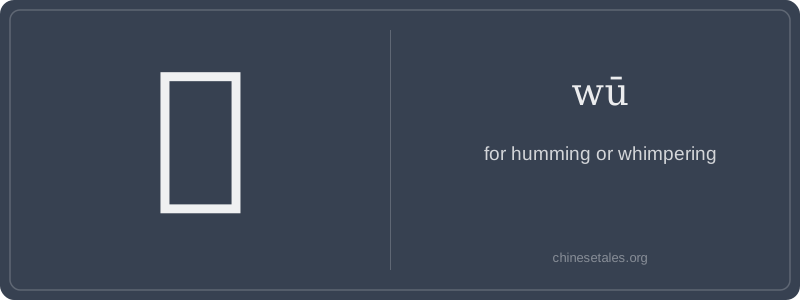
The earliest form of 呜 appears in bronze inscriptions as a combination of 口 (kǒu, ‘mouth’) and 乌 (wū, ‘crow’ — originally picturing a short-tailed bird with a dot for eye). But here’s the twist: 乌 wasn’t chosen for its meaning — it was borrowed purely for its *sound*. This makes 呜 a classic phonosemantic compound: 口 signals the domain (speech/sound), while 乌 provides the pronunciation clue. Visually, the modern character retains 口 on the left — three clean strokes forming the mouth frame — and 乌 on the right, simplified from its ancient bird shape into seven tidy strokes: a dot, horizontal, hook, then three connected curves mimicking folded wings and a beak.
Over time, 呜 shed any avian association and deepened its human resonance. In classical texts, it appears in poetry and drama as a vocalization of grief or tenderness — notably in Tang dynasty lyrics where lovers hum melancholy tunes. The visual link remains poetic: just as a crow’s call is soft and mournful at dusk, 呜 evokes sound that rises from the throat, not the lungs — warm, rounded, and close to the chest. Its enduring power lies in how little it says — and how much it conveys.
Imagine hearing a soft, breathy, almost involuntary sound — not quite speech, not quite song, but something tender, vulnerable, or deeply emotional: that’s 呜 (wū). It’s the written echo of humming a lullaby, whimpering when hurt, or sighing into your hands. Unlike onomatopoeic characters like 咚 (dōng, a thud) or 嘭 (pēng, a bang), 呜 captures *internalized* sound — quiet, resonant, and intimate. It’s never shouted; it’s exhaled.
Grammatically, 呜 functions almost exclusively as an interjection — like English ‘uh-huh’ or ‘mmhmm’, but with emotional texture. You’ll hear it in dialogue: ‘呜…我不想走’ (wū… wǒ bù xiǎng zǒu) — ‘Wū… I don’t want to leave’. It rarely appears alone in formal writing, but thrives in novels, subtitles, and chat messages where tone matters more than syntax. Crucially, it’s *not* a verb — you don’t ‘wu’ something — and it’s never used for animal cries (that’s 喵 or 喵喵 for cats). Learners sometimes mistakenly use it like 啊 or 哦, but 呜 carries a distinct emotional gravity: sorrow, comfort, fatigue, or quiet resistance.
Culturally, 呜 is the sound of unspoken feeling — think of a child burying their face in a parent’s shoulder, or someone stifling tears in public. Its softness reflects Chinese emotional restraint: expressing pain without drama, comfort without words. A common mistake? Overusing it in speech practice — native speakers deploy it sparingly, like a punctuation mark for the heart. Also, beware: it’s easily misread as 呜 (wū) vs. 污 (wū, ‘dirty’) — same pinyin, wildly different radicals and meanings!