嗙
Character Story & Explanation
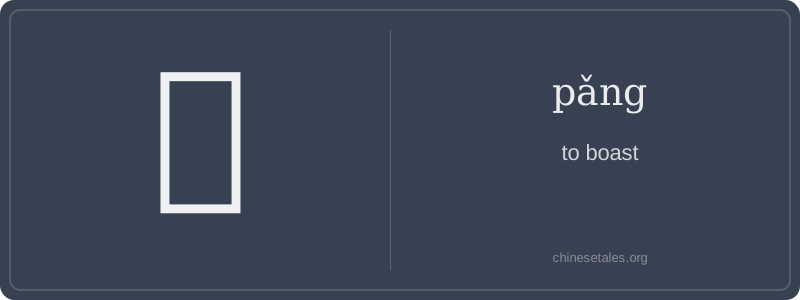
The earliest trace of 嗙 appears not in oracle bones, but in late Qing vernacular manuscripts — a deliberate folk invention. Its structure is brilliantly transparent: left side 口 (kǒu, 'mouth'), right side 旁 (páng, 'side, beside'), phonetically borrowed for sound (pǎng). There’s no ancient pictograph — it’s a 'phonosemantic compound' born from linguistic playfulness: 'mouth + beside' evokes words spoken *off to the side* — i.e., off-topic, exaggerated, or tangential to truth. Stroke by stroke, it’s built like a stage prop: the mouth opens wide (first three strokes), then 旁 unfolds like a curtain being pulled aside (remaining 8 strokes), revealing the performance.
Its meaning crystallized in early 20th-century Beijing storytelling and xiangsheng (crosstalk), where comedians used 嗙 to label the narrator’s own over-the-top embellishments — a wink to the audience saying, 'Yes, this is nonsense… and that’s the point.' Unlike classical boasting terms like 驕 (jiāo, 'arrogant') or 夸 (kuā, 'to praise/exaggerate'), 嗙 carries zero pretense of dignity. It’s self-mocking, meta, and deeply urban — a linguistic shrug that says, 'I know this is ridiculous… and so do you.'
Imagine hearing someone puff up their chest and let out a loud, exaggerated 'Pǎng!' — that’s the sound and spirit of 嗙. This character doesn’t just mean 'to boast'; it captures the *performative*, almost cartoonish quality of bragging — think chest-thumping, hair-tossing, 'I once lifted a water buffalo with one finger!' energy. It’s colloquial, vivid, and slightly mocking: you’d use it to describe someone’s tall tale, not a modest achievement. It’s almost always verbal (verb + object or used in 把/被 constructions), never adjectival — so you wouldn’t say 'a 嗙 person', but 'he 嗙了一通 about his fishing trip'.
Grammatically, 嗙 is almost exclusively used in the reduplicated form 嗙嗙 or as part of the fixed phrase 嗙大话 (pǎng dàhuà, 'to tell whoppers'). You’ll rarely see it alone in formal writing — it lives in spoken dialects (especially Northern Mandarin), internet slang, and satirical dialogue. Learners often mistakenly treat it like a neutral synonym for 吹 or 夸, but 嗙 carries stronger connotations of absurdity and self-aware exaggeration — it’s less 'I’m good at cooking' and more 'My dumplings once made a panda weep with joy!'
Culturally, 嗙 thrives in storytelling, stand-up comedy, and online memes where hyperbole is the punchline. A common trap? Confusing its mouth radical (口) with characters meaning 'speak' generically — but here, 口 isn’t just speech; it’s the *sound effect* of inflated hot air escaping. It’s not in HSK because it’s too informal and regionally flavored — yet it’s instantly recognizable to native speakers as the linguistic equivalent of a cartoon 'POOF!' bubble.