嗖
Character Story & Explanation
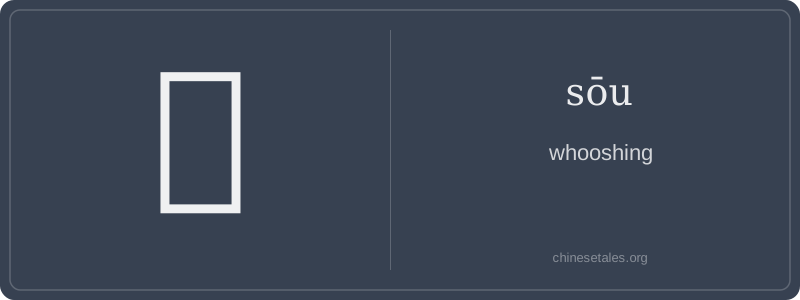
The earliest form of 嗖 doesn’t appear in oracle bones or bronzes — it’s a latecomer, born from linguistic need rather than ancient ritual. Its structure is brilliantly transparent: left side 口 (kǒu, 'mouth'), signaling it’s a spoken sound; right side 肅 (sù, now simplified to 肃), which originally depicted a person standing solemnly with hands clasped — but here, it’s purely phonetic, lending the 'sōu' sound. Over centuries, 肅 was streamlined: the top 'spear-like' strokes softened, the middle 'feet' became two dots, and the bottom 'net' evolved into the modern 肀 — all while preserving the essential 'sōu' pronunciation. Twelve strokes total — each one contributing to its sharp, staccato visual rhythm.
This character emerged fully formed in late imperial vernacular fiction, where storytellers needed punchy, vivid ways to animate action. You won’t find 嗖 in the Analects or Tang poetry — but you’ll hear it crackle in Ming-dynasty martial novels like Water Margin, where arrows 'sōu' through bamboo groves, or in early 20th-century children’s rhymes mimicking wind or rockets. Its shape mirrors its function: the mouth radical opens wide to release sound; the right side’s angular, downward-slanting strokes visually echo the trajectory of something speeding *past* — not toward or away, but *whizzing by*. It’s not about origin — it’s about *passage*.
Think of 嗖 (sōu) as the Chinese onomatopoeic *snap* of sound — not a word you’ll find in formal essays or HSK exams, but one that zips through cartoons, action novels, and kids’ storytelling like a laser beam. It captures the sharp, high-speed, directional 'whoosh' of something flying past: an arrow, a bullet, a startled bird taking off, or even your phone notification ping in meme-speak. Its core feeling is *instantaneous motion with audible trail* — not just speed, but the *audible signature* of velocity.
Grammatically, 嗖 is almost always used as an adverbial interjection or standalone sound effect — often reduplicated (嗖嗖) for intensity or rhythm, or paired with verbs like 飞过 (fēi guò, 'fly past') or 射出 (shè chū, 'shoot out'). It rarely appears alone as a sentence; instead, it’s sprinkled into narratives for kinetic flavor: '嗖!一支箭射穿了靶心。' (Sōu! Yī zhī jiàn shè chuān le bǎ xīn.) — note how it lands *before* the verb, acting like an auditory exclamation point. Learners sometimes wrongly treat it as a verb ('to whoosh') or try to use it in formal writing — big no-no: it’s playful, colloquial, and context-dependent.
Culturally, 嗖 belongs to China’s rich tradition of expressive sound-words (拟声词 nǐshēngcí), where phonetics trump etymology. Unlike English ‘whoosh’, which hints at airflow, 嗖’s mouth-radical (口) signals its vocal, performative nature — it’s meant to be *said aloud*, not just read. A common mistake? Confusing it with similar-sounding sū or sǒu characters — but 嗖 has zero semantic baggage beyond sound; it carries no abstract meaning, no historical weight, just pure sonic velocity. That’s its charm — and its limitation.