嗕
Character Story & Explanation
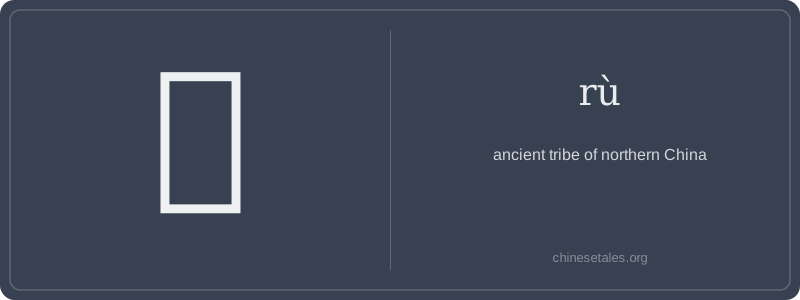
The earliest attested form of 嗕 appears not in oracle bones—but in late Warring States bronze inscriptions and bamboo slips, where it was written as a compound glyph: 口 (mouth/speech) + 若 (a phonetic component suggesting pronunciation, possibly mimicking tribal chant or war cry). The 口 radical signals its association with named peoples—just like 吴 (Wu), 越 (Yue), or 鲜 (Xian)—all denoting ethnic groups whose identities were recorded through spoken names. Over time, the right-hand side standardized into 若, losing earlier variants with 禾 or 艹 elements that hinted at agricultural ties now lost to history.
By the Han dynasty, 嗕 had solidified as a historical ethnonym, appearing in Sima Qian’s Shiji when listing pre-Qin northern threats. Its meaning never broadened—it didn’t evolve into 'barbarian' (夷) or 'nomad' (游牧); it stayed stubbornly specific, like 'Etruscans' in Latin texts. Intriguingly, its pronunciation rù (not ruò) reflects an ancient dialectal shift—perhaps the tribe’s own rendering preserved in early transcription. The character’s visual austerity—no decorative strokes, no semantic redundancy—mirrors its function: a precise, archival label, not a living word.
Imagine you’re reading a dusty Tang dynasty stele inscription in Inner Mongolia, and suddenly—there it is: 嗕. Not a verb, not an adjective, not even a common noun—it’s a proper noun frozen in time, like 'Visigoths' or 'Huns' in English. This character doesn’t describe an action or quality; it names a specific ancient tribal confederation that roamed the northern steppes during the early Zhou to Warring States periods. You’ll never hear it in daily speech, nor see it on menus or subway signs—it lives only in classical texts, archaeological reports, and scholarly footnotes.
Grammatically, 嗕 functions exclusively as a rigid, uninflected proper noun—no measure words, no modifiers, no reduplication. It never takes aspect particles (了, 过, 着), nor does it combine freely with verbs like 'attack' or 'ally with'. You’d say '喎喎之喎' (a rare phrase) but never '*喎人' or '*喎地'—the character resists derivation. Learners mistakenly treat it like a regular noun and try to pluralize or modify it, but it’s linguistically fossilized: one tribe, one name, zero grammatical flexibility.
Culturally, 嗕 carries quiet weight: it appears in the Zuo Zhuan and Shiji as part of triadic tribal references (e.g., 嗕、狄、戎), reflecting early Chinese ethnographic taxonomy—not pejorative, but categorically distant. Modern scholars debate whether it referred to a linguistic group, a political coalition, or a shifting frontier identity. Crucially, it’s *not* interchangeable with 匈奴 (Xiongnu)—that’s a later, historically distinct entity. Confusing them is like calling Vikings 'Normans' before 1066: chronologically and culturally off by centuries.