嗐
Character Story & Explanation
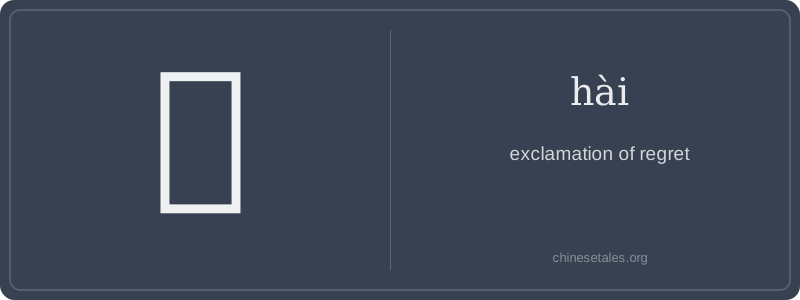
The earliest form of 嗐 appears not in oracle bones, but in late Ming dynasty vernacular manuscripts — a deliberate graphical invention, not an ancient pictograph. Its structure is brilliantly transparent: left side 口 (kǒu, 'mouth') anchors it as a vocalization; right side 是 (shì, 'to be') is borrowed *phonetically*, not semantically — the ancient pronunciation of 是 in Middle Chinese was /zɨH/, close enough to /hài/ to serve as a sound cue. Over centuries, the top of 是 simplified from 日 + 止 to the modern 曰 + 止-like shape, and the bottom stroke curved inward, yielding today’s 13-stroke form: mouth + phonetic 'shì' — a visual pun on 'the mouth that sounds like “shì” but means “hài.”'
This character emerged precisely when vernacular fiction exploded — in novels like Jin Ping Mei and Dream of the Red Chamber — where authors needed nuanced, spoken-style interjections to convey inner voice. Classical Chinese had no native character for this specific sigh; writers improvised, combining 口 with a familiar, easy-to-write phonetic. The meaning crystallized around Qing dynasty: not just 'regret,' but *self-aware regret* — the speaker acknowledges their own role in the mishap ('Hài, I should’ve known better'). That self-referential nuance is baked into its design: mouth + 'is' → 'this is me, sighing at my own folly.' No wonder it thrives in dialogue-heavy genres — it’s linguistic stage direction.
Think of 嗐 as Chinese ‘alas!’ — but with the theatrical sigh of a Shakespearean actor collapsing onto a velvet chaise lounge after misplacing his favorite quill. It’s not anger, not panic, not even sadness: it’s that deeply human, slightly performative exhalation of regret — the sound you make when you realize you’ve just sent a text to your boss instead of your best friend, or when your dumpling soup spills *just* as you lift the spoon. Unlike English interjections, 嗐 stands alone — never modifies verbs or nouns, never takes particles like 啊 or 吧. It’s a grammatical island: always sentence-initial, often followed by a pause (comma or ellipsis), and almost always paired with body language — a head shake, palm-up shrug, or slow exhale.
Grammatically, it’s a free-floating emotional anchor: 嗐,我忘了带伞! (Hài, wǒ wàng le dài sǎn!) — no subject-verb agreement needed, no tense marking; just pure, unfiltered ruefulness. Learners often mistakenly tack it onto the end of sentences ('...sǎn hai!') or confuse it with question particles — but 嗐 has zero syntactic function beyond signaling 'I’m emotionally surrendering to this minor tragedy.' It’s also wildly context-sensitive: used ironically among friends ('Hài, another Zoom meeting?'), tenderly with children ('Hài, bù kě’ài de xiǎo dōngxi…'), or bitterly in novels when fate delivers cruel irony.
Culturally, 嗐 carries subtle class and generational texture: more common in northern dialects and literary dialogue than in formal writing or Gen-Z social media (where '啊这…' dominates). Mistake it for a filler word like 呃 or 啊, and you’ll miss its precise emotional calibration — it’s not hesitation; it’s *resignation*. And crucially: it’s never used in anger (that’s 哼 or 哼!) or surprise (that’s 哎呀!). Confuse it with those, and your 'Hài!' might accidentally sound like a petulant teenager rather than a world-weary poet.