嗍
Character Story & Explanation
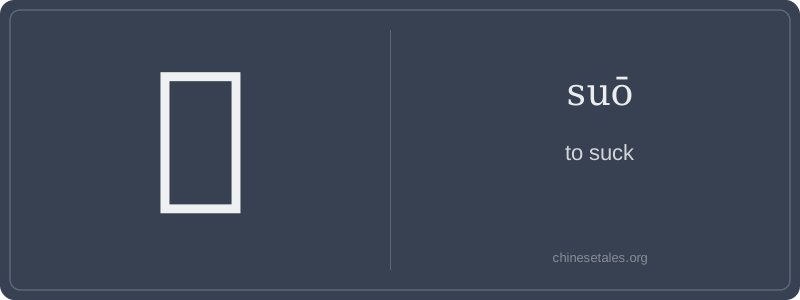
The earliest trace of 嗍 isn’t in oracle bones — it’s a latecomer, emerging fully only in Song-Yuan vernacular texts. Its structure is brilliantly literal: the left side 口 (kǒu, 'mouth') anchors the meaning, while the right side 朔 (shuò, originally picturing a new moon — — and later meaning 'first day of month') was borrowed purely for sound. Wait — why 朔? Because in Middle Chinese, 朔 was pronounced *sak*, close to the sucking ‘suō’ sound, and scribes loved phonetic loans. Over centuries, 朔’s strokes simplified: its original 'moon + gate' composition (屰+月) collapsed into today’s streamlined +月 shape, fused tightly with 口 to form the 13-stroke 嗍 we write now.
This character didn’t exist in classical poetry or Confucian classics — it’s a folk invention, born from spoken language’s need to capture the wet, rhythmic *schlllup* of suction. By the Ming dynasty, it thrived in vernacular novels like Water Margin, where bandits ‘嗍酒’ (suō jiǔ) — not 'drink', but *suck down liquor* straight from a gourd, lips sealed tight. The mouth radical isn’t decorative: every time you write those three strokes of 口, you’re drawing the very aperture doing the sucking — making 嗍 a rare character whose form, sound, and function all converge on one delicious, messy action.
Think of 嗍 (suō) as the *sound-effect character* for suction — not just a dry dictionary definition, but a visceral, onomatopoeic verb that makes your mouth pucker. It’s not abstract or formal: it’s what babies do at the breast, what you do when slurping noodles too eagerly, or what a vacuum cleaner *wishes* it could do. Unlike generic 吸 (xī), which means 'to inhale' or 'to absorb' in scientific or metaphorical contexts (e.g., 吸收 knowledge), 嗍 is intensely physical, oral, and often informal — even playful or slightly childish.
Grammatically, it’s a transitive verb, almost always followed by an object (e.g., 嗍手指 suō shǒuzhǐ — 'suck one’s finger'), and frequently appears in reduplicated form 嗍嗍 (suō suō) to emphasize repeated action or cuteness — like a toddler mimicking the sound. Learners sometimes wrongly use it for 'drink' (that’s 喝 hē) or 'inhale smoke' (that’s 吸 xī); 嗍 implies direct oral contact with the object and active lip/tongue suction. It rarely appears in written formal texts — you’ll hear it far more often in speech, cartoons, or dialect-rich storytelling.
Culturally, 嗍 carries warmth and intimacy — think of a grandmother saying ‘来,嗍口汤’ (Come, suck up some soup!) meaning ‘sip it slowly, let it warm you.’ But beware: in some southern dialects (like Min Nan), 嗍 can carry slangy or vulgar undertones depending on context — so stick to standard Mandarin usage unless you’re deep in regional fluency. Also, never confuse it with the similar-looking 梭 (suō, 'shuttle') — no mouth involved there!