呛
Character Story & Explanation
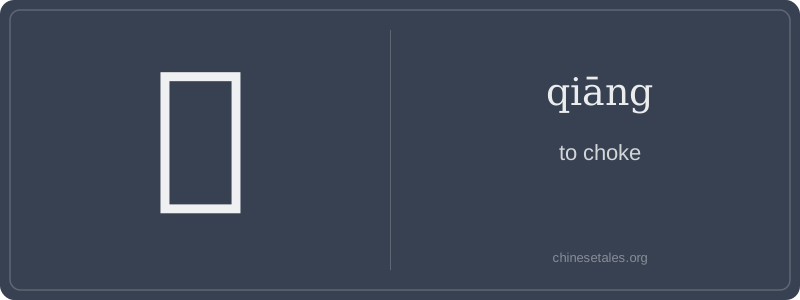
The earliest form of 呛 appears in seal script as a combination of 口 (mouth/throat) and 仓 (cāng), which itself evolved from a pictograph of a granary with a roof and storage bins. But here’s the twist: 仓 wasn’t chosen for its meaning — it was borrowed *for its sound* (cāng → qiāng via phonetic shift). Visually, the modern 呛 retains 口 on the left (7 strokes total: 口 [3] + 仓 [4]) — the mouth radical anchoring the meaning, while 仓 provides both phonetic cue and a subtle visual echo of ‘stuff rushing in’ (granaries overflow; smoke/pepper rushes into the throat).
This is a classic ‘phono-semantic compound’: meaning from 口, sound from 仓. Unlike many characters whose meanings drifted metaphorically (e.g., ‘mouth’ → ‘speech’), 呛 stayed fiercely literal — always tied to physical airway distress. In classical texts, it appears sparingly in medical manuscripts describing ‘smoke-injury to the throat’ (《本草纲目》), but exploded in colloquial use during the Ming-Qing vernacular fiction boom, where authors loved onomatopoeic verbs like 呛 to dramatize spicy meals or sudden shocks — cementing its role as the go-to word for that unmistakable, breath-stealing ‘ah-CHOK!’ moment.
Imagine you’re slurping hot, spicy Sichuan noodles — steam rising, chili oil glistening — and suddenly a rogue peppercorn shoots up your windpipe. Qiāng! That sharp, involuntary gasp, the tearing eyes, the frantic coughing? That’s 呛 in action. It’s not just ‘choking’ like a life-threatening obstruction (that’s 噎 or 窒息); it’s the visceral, reflexive *irritation* of something foreign — smoke, pepper, strong alcohol vapors, or even sarcasm so biting it makes you recoil. It’s sensory shock to the throat and lungs.
Grammatically, 呛 is almost always a verb, used transitively: someone or something *causes* the choking sensation (tā bèi là jiāo qiāng le — 'She got choked by the chili'). You’ll also see it in passive constructions and as a resultative complement (e.g., hē qiāng le — 'drank and choked'). Crucially, it’s rarely used for food *stuck* in the throat — that’s 噎. Learners often overuse 呛 for general ‘coughing’ or ‘sneezing’, but those are 咳 and 打喷嚏. 呛 is specifically about *airway irritation*, not illness.
Culturally, 呛 carries a spicy, almost theatrical energy — it appears in cooking shows ('Watch out, this sauce will qiāng your nose!'), stand-up comedy ('His jokes were so sharp they qiāng the audience!'), and even tech slang ('That error message qiānged my browser'). The alternate pronunciation qiàng appears only in rare dialectal or archaic compounds (e.g., qiàng yào, an old term for ‘to fumigate’) — ignore it for now; qiāng covers 99% of modern usage.