嗄
Character Story & Explanation
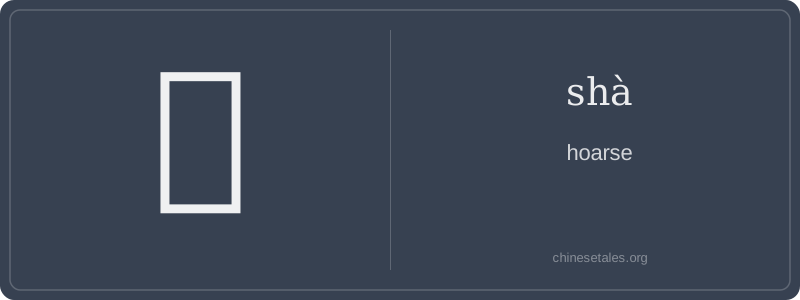
The earliest form of 嗄 appears in late Warring States bamboo texts as a compound glyph: the ‘mouth’ radical 口 on the left, paired with a variant of 葛 (gé, a climbing plant with tangled vines) on the right — not the modern 夏. That original right-hand component depicted twisting, knotted stems, visually evoking constriction and obstruction. Over centuries, the vine-like strokes simplified and stylized, merging phonetically with 夏 (xià) due to shared ancient pronunciation — eventually yielding today’s 13-stroke structure where the ‘summer’ component hints at heat-induced vocal strain (a folk etymology that stuck).
By the Tang dynasty, 嗄 shed its botanical roots and solidified as a vocal descriptor — appearing in Dunhuang manuscripts to render the guttural cries of monks chanting under duress. Li Bai used it in a lost fragment quoted by Song scholars to describe the ‘dry-throated caw of the crow at dusk’. Its meaning never broadened; instead, it narrowed into a precise sonic signature: not silence (哑), not whisper (低), but the friction of air scraping past swollen vocal cords. The mouth radical anchors it firmly in embodied sound — this isn’t abstract; it’s what your throat *feels* like after yelling across a canyon.
嗄 is a vivid, onomatopoeic character that captures the raw, raspy texture of a strained voice — think clearing your throat mid-sentence or shouting until your voice cracks. It’s not just ‘hoarse’ as a clinical descriptor; it’s visceral and expressive, often used to convey emotional exhaustion, urgency, or physical strain. Unlike the more neutral 哑 (yǎ, mute/voiceless), 嗄 implies sound *is* being produced — just broken, grating, and effortful.
Grammatically, 嗄 functions almost exclusively as an adverbial modifier or interjection — rarely as a standalone verb or adjective. You’ll most often see it in reduplicated form 嗄嗄 (shà shà) describing *how* someone speaks or cries, or as part of literary exclamations like ‘嗄?!’ (Shà?! — ‘What?!’, with a choked, incredulous tone). It never appears in casual speech or modern textbooks — but pops up in classical poetry, opera libretti, and contemporary writing aiming for dramatic vocal texture (e.g., ‘他嗄着嗓子喊’ — ‘He shouted with a hoarse voice’).
Culturally, 嗄 carries theatrical weight: in Peking opera, it signals a character’s moral fatigue or impending collapse; in Ming-Qing fiction, it marks moments of spiritual crisis or suppressed grief. Learners often misread it as shā (like 杀) or confuse it with 哑 (yǎ), missing its breathy, aspirated quality. Crucially, it’s *not* used for chronic voice loss — only for transient, effortful, audible rasp. Its rarity means context is everything: if you see it, expect drama, not diagnosis.