嗃
Character Story & Explanation
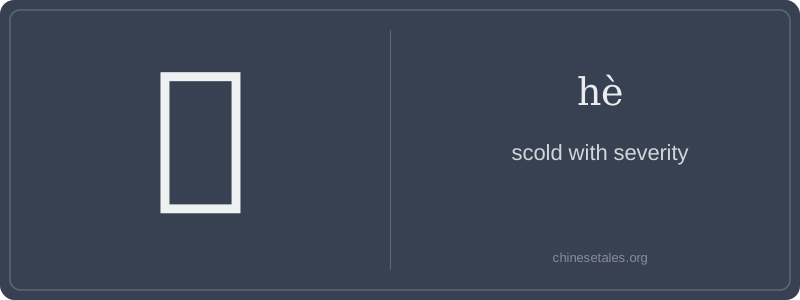
The earliest form of 嗃 appears in late Warring States bamboo slips and Han dynasty seals, where it was written as 口 + 隺 — not the modern 隼 (falcon) radical many assume. 隺 was a stylized crane (鶴) with extended neck and sharp beak, symbolizing vocal projection and vigilance. Over centuries, clerical script simplified 隺 into 隼 (a falcon-like shape), while the 口 remained prominent at left — visually anchoring the idea of a mouth launching a penetrating sound, like a crane’s call slicing across misty marshes.
This phonosemantic evolution wasn’t arbitrary: cranes were revered in early Chinese cosmology for their clarity, longevity, and piercing calls — perfect metaphors for authoritative speech. By the Tang dynasty, 嗃 appeared in official histories describing ministers ‘hè chì’ (嗃斥) — sharply reprimanding corrupt officials — reinforcing its association with upright, public-facing censure. Unlike generic scolding, 嗃 always implied the speaker’s moral high ground and the listener’s clear breach of propriety; its visual structure literally shouts: ‘This rebuke comes from the mouth of principle.’
At its core, 嗃 (hè) isn’t just ‘to scold’ — it’s the sound of a voice cracking with moral authority: sharp, guttural, and unmistakably stern. Think less ‘nagging’ and more ‘a headmaster’s reprimand echoing down a silent hallway’. It carries visceral weight — the character itself is built from 口 (mouth) + 隺 (an archaic variant of 鶴, crane), evoking the piercing, far-carrying cry of a crane used metaphorically for a voice that cuts through noise and complacency.
Grammatically, 嗃 is almost exclusively literary or classical. You won’t hear it in casual speech or modern news — it appears mainly in written narratives, historical fiction, or formal critique. It functions as a verb, usually transitive, often followed by an object (e.g., 嗃斥). Learners mistakenly treat it like common verbs like 批评 or 责备, but 嗃 demands gravitas: it implies the scolder holds legitimate hierarchical or ethical standing, and the rebuke is both sudden and morally unassailable.
Culturally, 嗃 reflects a Confucian ideal of righteous correction — not anger for its own sake, but sternness as duty. Modern learners overuse it trying to sound ‘authentic’, landing in awkward, overly dramatic territory. Also, be warned: this character is *not* in any HSK list and appears in fewer than 0.001% of contemporary texts — encountering it is like spotting a rare bird in urban Beijing. Its rarity makes it a linguistic fossil — beautiful, precise, and utterly out of place on WeChat.