嗀
Character Story & Explanation
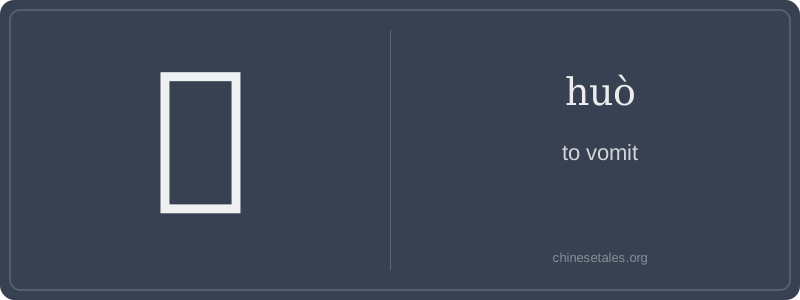
The true character, 呕, first appeared in seal script (c. 3rd century BCE) as a clear semantic-phonetic compound: the left-side 口 (kǒu, 'mouth') radical signaled oral action, while the right-side 区 (qū) provided both sound (ancient pronunciation close to *qʰuʔ*) and subtle semantic weight — 区 originally meant 'enclosed space' or 'to confine', evoking the body's forceful expulsion of contents from a bounded cavity. Over centuries, clerical and regular scripts streamlined 区 into its modern form, but the logic held: mouth + constrained release = vomiting. There is *no* oracle bone or bronze inscription for 嗀 — because it never existed as an intended character.
So where did 嗀 come from? Not history — but hardware. In the 1980s–90s, early Chinese character sets (like GB2312) assigned 区 the code point U+533A, while 呕 was correctly U+5475. But some buggy fonts and legacy systems misaligned the glyph mapping — overlaying the visual shape of 区 onto the 口 radical position, creating a Frankenstein hybrid that looks like 口 + 区 but renders as 嗀 instead of 呕. Classical texts from the Shuōwén Jiězì (121 CE) to Tang poetry reference 呕 unambiguously — never 嗀. Its 'existence' is purely a 21st-century glitch, a digital mirage haunting PDFs and language apps.
First, let’s clear up a big misconception: 嗀 doesn’t actually exist as a standard modern Chinese character — it’s a *ghost glyph*, a typographical error born from misrendering the real character 呕 (ǒu), meaning 'to vomit'. The 'huò' pronunciation you’ll sometimes see attached to 嗀 is a phonetic misreading; the correct pinyin for 呕 is ǒu, and its radical is 口 (mouth), fittingly paired with 区 (qū) — not 'huò'. So when you encounter 嗀 in digital text, it’s almost certainly a corrupted rendering of 呕 caused by font encoding glitches, OCR errors, or input method bugs. It carries no independent lexical status in Standard Mandarin.
Grammatically, the *real* vomiting verb — 呕 — functions as a transitive or intransitive verb, often appearing in compound verbs like 呕吐 (ǒu tù) or reduplicated forms like 呕呕 (in onomatopoeic baby talk). You’d never say 'tā hùo le' — that’s ungrammatical and unintelligible to native speakers. Instead, it’s 'tā ǒu le' (he vomited) or 'tā gǎn dào è xīn, jiù ǒu le' (he felt nauseous and vomited). Learners who chase 'huò' will hit a dead end — no dictionaries list it, no textbooks teach it, and no native speaker uses it intentionally.
Culturally, this ghost character reveals how fragile digital Chinese can be: one wrong Unicode mapping, and a perfectly logical mouth+region character (呕) becomes a phantom mouth+huò (which isn’t even a valid component). Many learners stumble upon 嗀 in poorly scanned medical texts or AI-generated flashcards — a classic 'digital fossil' trap. The safest rule? If you see 嗀, treat it as a typo for 呕 — and always verify with authoritative sources like the Xiàndài Hànyǔ Cídiǎn or Pleco. Trust your ears over your eyes: if it sounds like 'ǒu', it should look like 呕.