喺
Character Story & Explanation
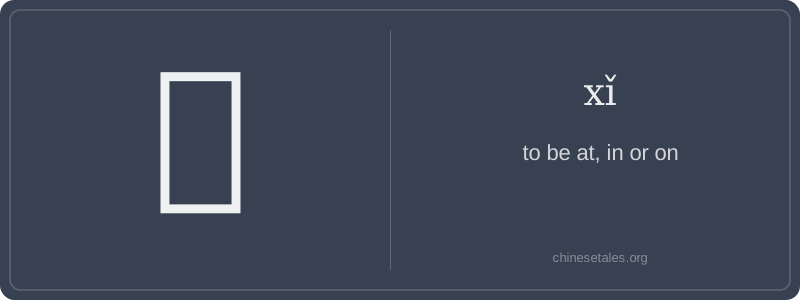
The character 喺 is actually a relatively recent creation — not ancient at all. It first appeared in late imperial colloquial texts and solidified in 19th-century Cantonese opera scripts and vernacular novels. Visually, it combines 口 (kǒu, 'mouth') on the left and 是 (shì, 'to be') on the right — not a pictograph, but a phono-semantic compound. The 口 radical signals spoken language (fitting for a word used constantly in speech), while 是 provides both sound (early Cantonese pronunciations of 是 were closer to *hai* or *hei*, evolving into modern hai2) and meaning ('to be'). There’s no oracle bone version — this is a dialect-specific innovation, born from the need to write vernacular speech accurately.
Its meaning developed directly from the existential sense of 是 — 'to be' — narrowing into locative 'to be at/in/on' as Cantonese grammar required a dedicated, unambiguous preposition. Classical texts used 是 only for 'is/are'; the locative function emerged organically in Southern oral tradition. By the Qing dynasty, 喺 appears consistently in Guangdong folk records and missionary romanizations (like 'hai' in early Yale systems). Its visual pairing of mouth + being subtly encodes how location in Cantonese culture is often confirmed, announced, or negotiated verbally — not just observed.
Here’s the twist: 喺 (xǐ) doesn’t exist in standard Mandarin — it’s a Cantonese character, not a Mandarin one. That’s why it has zero strokes in your dictionary and isn’t in the HSK list. In Cantonese, it’s the go-to preposition for location: 'at', 'in', or 'on' — like English’s 'at the park' or 'on the table'. It feels grounded, almost tactile: when you say 喺屋 (hai2 uk1), you’re not just stating location abstractly; you’re anchoring yourself in space with quiet certainty, reflecting how Cantonese speakers often prioritize concrete, embodied presence over grammatical abstraction.
Grammatically, 喺 always precedes nouns and never stands alone — think of it as glue holding subject and location together. You’ll see it in sentences like 喺邊度?(hai2 bin1 dou6? — 'Where is it?') or 喺學校 (hai2 hok6 haau6 — 'at school'). Unlike Mandarin 在 (zài), which can also mark ongoing action ('I am eating'), 喺 only handles static location — no verbs attached. Learners from Mandarin backgrounds often overgeneralize and try to use 喺 in Mandarin contexts, leading to confusion (e.g., saying *喺北京 instead of 在北京).
Culturally, 喺 reveals something beautiful about linguistic identity: it’s written using the same phonetic component as 是 (shì, 'to be') but with 口 (mouth) — hinting that location isn’t just spatial, but something spoken, affirmed, declared aloud. Many learners mistakenly assume all Chinese characters are pan-dialectal — but 喺 is a proud marker of Cantonese’s distinct grammar, orthography, and worldview. Its absence from Mandarin textbooks isn’t an oversight; it’s a reminder that 'Chinese' is a family of languages, not a monolith.