喵
Character Story & Explanation
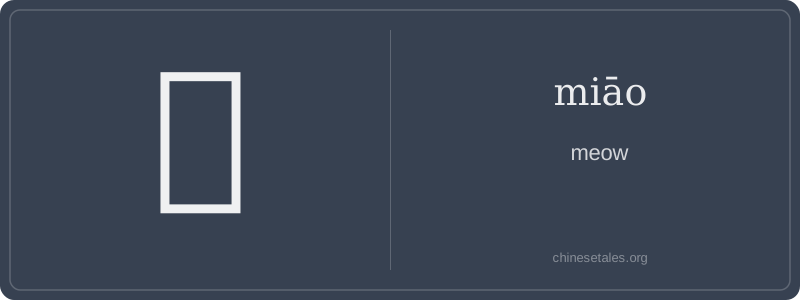
喵 has no ancient oracle bone or bronze script form—it’s a modern invention, born not from millennia-old ritual inscriptions, but from early 20th-century cartoonists and children’s writers who needed a way to write the cat’s cry. Its structure is brilliantly transparent: the left-side 口 (kǒu, ‘mouth’) radical anchors it as a vocalization, while the right side 苗 (miáo, ‘sprout’ or ‘seedling’) was chosen purely for its sound—miāo rhymes closely with miáo, making this a classic *phonetic-semantic compound* (形声字). No sprouts involved—just clever sound-matching.
The character first appeared in print around the 1920s–30s in illustrated magazines and nursery rhymes, gaining traction alongside Japan’s influence on Chinese manga aesthetics (where neko sounds like にゃん/nyan). Though absent from classical texts, its rapid adoption reveals how Chinese writing flexibly absorbs new communicative needs—even playful, non-utilitarian ones. Visually, the 11 strokes flow with a soft, rounded rhythm: the 口 is compact and open; 苗’s grass-head (艹) suggests delicate movement, and its ‘field’ (田) base grounds the sound—like a tiny vocal field where feline expression grows.
喵 (miāo) isn’t just a sound—it’s a linguistic wink: Chinese doesn’t treat animal vocalizations as mere noise, but as *intentional utterances* worthy of their own characters. Unlike English ‘meow’, which is spelled phonetically but lacks grammatical weight, 喵 functions as an onomatopoeic verb, interjection, or even a noun—and carries gentle, often affectionate connotations. You’ll hear it in children’s books, anime dubs, and pet influencers’ captions—not in formal reports, but very much in real, warm, human-centered communication.
Grammatically, 喵 behaves like a light verb: it can stand alone as a quoted utterance (‘She went 喵!’), follow verbs like 叫 (jiào, ‘to call’) or 学 (xué, ‘to imitate’), or appear reduplicated (喵喵) for emphasis or cuteness. Crucially, it rarely takes aspect particles like 了 or 过—its charm lies in its immediacy and playfulness. Learners sometimes overuse it trying to sound ‘fluent’, but native speakers deploy it sparingly, usually with tone or context that signals teasing, endearment, or anthropomorphism.
Culturally, 喵 reflects China’s long tradition of *shēnglǜ* (sound-logic)—where speech sounds aren’t arbitrary, but echo emotional resonance. Interestingly, while cats were historically less central in agrarian China than dogs or chickens, the rise of urban pet culture since the 2000s has rocketed 喵 into internet slang (e.g., 喵星人 ‘cat-planet people’ for cat lovers). A common mistake? Writing it as 妙 (miào, ‘wonderful’) by ear—proof that pronunciation alone won’t save you without visual literacy!