喳
Character Story & Explanation
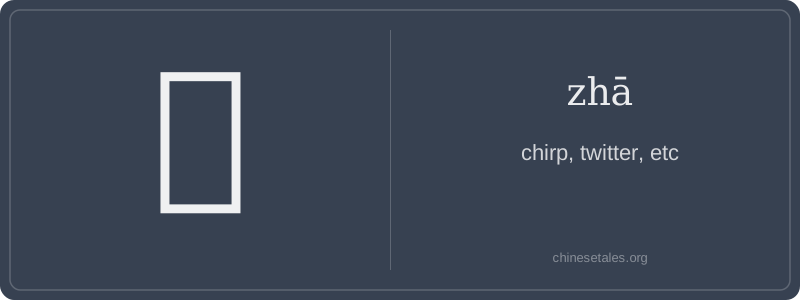
The character 喳 first appeared in seal script during the Warring States period, evolving from a combination of 口 (kǒu, 'mouth') and 查 (chá, originally meaning 'to inspect' but here serving phonetically). Its earliest form wasn’t pictographic at all — there’s no bird, no beak, no wing. Instead, it was a classic phono-semantic compound: the left-side 口 signals speech/sound, while the right-side 查 (pronounced *chá* in modern Mandarin, but *zhā* in Old Chinese) provided the ancient pronunciation. Over centuries, the 查 component simplified: its top 爪 (claw) became ⺮ (bamboo), then further stylized into the modern 曰-like shape above the 日, while strokes condensed into today’s clean 12-stroke structure.
This visual evolution mirrors its semantic journey: from a neutral phonetic signifier to a highly specific auditory icon. By the Ming and Qing dynasties, 喳 had crystallized in vernacular literature — notably in *The Scholars* and *Dream of the Red Chamber* — where 嘰嘰喳喳 vividly paints scenes of bustling teahouses or servants gossiping behind fans. The character’s mouth radical + ‘inspection’-derived sound creates a subtle irony: what begins as a tool for scrutiny ends up representing the very opposite — unstructured, spontaneous, even frivolous vocal overflow.
Think of 喳 (zhā) as Chinese onomatopoeia’s punk-rock cousin — it’s not just 'chirp' like the gentle *jī jī* of a sparrow; it’s the sharp, insistent, slightly chaotic *zhā!* of starlings mobbing a rooftop or gossiping neighbors leaning over a courtyard wall. It captures rapid, overlapping, often trivial vocal noise — less birdcall, more human chatter with feathers. You’ll almost never see it alone: it’s nearly always reduplicated (嘰嘰喳喳) or paired in fixed expressions, functioning like English ‘chatter-chatter’ or ‘clack-clack’ — a sound unit, not a verb.
Grammatically, 喳 is strictly an onomatopoeic syllable used adverbially or within reduplicated compounds. It doesn’t conjugate, take objects, or appear in formal writing. Learners sometimes mistakenly try to use it like a verb (*‘She zhās’*), but no — it only lives inside phrases like 嘈雜 (cáo zá, noisy) or as part of the iconic four-character idiom 嘰嘰喳喳. Its power lies in rhythm and repetition: two 喳 sounds together (嘰嘰喳喳) instantly evoke a buzzing, unfiltered, slightly overwhelming auditory texture.
Culturally, 喳 carries light-hearted, mildly disapproving connotations — think of a teacher gently shushing students who are ‘zhā-ing’ too loudly during quiet time. It’s rarely poetic or solemn; it’s urban, colloquial, and faintly humorous. A common error is overgeneralizing it to any bird sound — but while sparrows *jī jī*, magpies *zhā zhā*, and crows *gā gā*, each has its own sonic fingerprint. Using 喳 for a solemn crane call would sound comically wrong — like replacing a cello’s hum with a kazoo solo.