乔
Character Story & Explanation
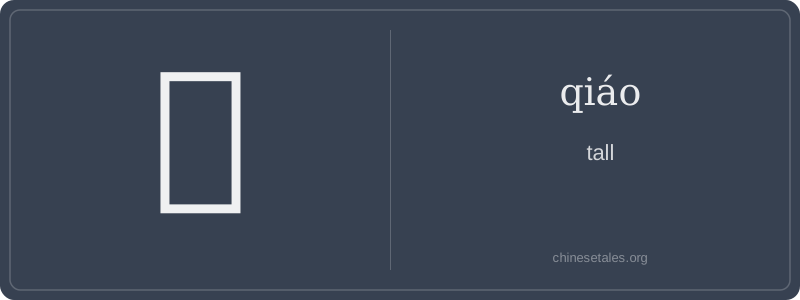
The earliest form of 乔 appears in bronze inscriptions (c. 1000 BCE) as a stylized figure standing tall on a platform—two legs beneath an exaggeratedly long torso and raised arms, all anchored by a broad base resembling the radical 大 (‘big’ or ‘adult’). Over centuries, the top evolved into 呵 (a simplified phonetic hint), while the lower part condensed into 丿 and 一—yet the core idea remained: a person standing upright, elevated, commanding presence. By the seal script era, it had stabilized into its modern six-stroke form: 大 + 丿 + 一—visually echoing a strong, balanced, upward-reaching stance.
This pictorial origin directly shaped its semantic path: from ‘standing tall’ → ‘lofty, elevated’ → ‘grand, distinguished’ (as in 乔装, ‘disguise’—originally ‘to assume a lofty, altered appearance’). In the Shuō Wén Jiě Zì (121 CE), Xu Shen defined 乔 as ‘high; lofty; to raise up’, citing classical phrases like ‘乔岳’ (qiáo yuè, ‘lofty mountain’). Its use in 乔迁 (first attested in the Book of Songs) reflects ancient reverence for upward movement—not just physically, but socially and spiritually—as a sign of blessing and renewal.
Imagine you’re hiking in the misty mountains of Anhui, and your guide points to a towering, ancient pine—its branches reaching skyward like arms stretching for the clouds. He says, '看那棵乔松!' (kàn nà kē qiáo sōng!). That ‘乔’ isn’t just ‘tall’ in a textbook sense—it’s *elevated*, *gracefully lofty*, with a quiet dignity that implies natural grandeur, not just height measured in meters. In Chinese, 乔 almost never stands alone as an adjective like ‘tall’ in English; it lives inside compound words (like 乔木 or 乔迁) or appears in classical or literary contexts—it’s elegant, slightly formal, and rarely used in casual speech like 高 (gāo).
Grammatically, 乔 is mostly a morpheme—not a free-standing word. You won’t say ‘他很乔’ (that would sound bizarre and wrong). Instead, it pairs: 乔木 (qiáo mù, ‘arborescent tree’, i.e., trees with a single trunk and canopy—contrasted with 灌木, shrubs); 乔迁 (qiáo qiān, ‘auspicious move’, used only for moving into a new home, never an office or dorm). Learners often mistakenly substitute 乔 for 高 in everyday speech—but doing so sounds like quoting a Tang dynasty poem at a coffee shop: charming, but wildly out of place.
Culturally, 乔 carries auspicious weight—especially in 乔迁之喜 (qiáo qiān zhī xǐ), the traditional phrase for celebrating a housewarming. The character subtly evokes Confucian ideals of upward moral growth and harmonious ascent—not just physical elevation. A common error? Writing 乔 instead of 桥 (qiáo, ‘bridge’) because they share pronunciation—but their meanings and radicals (大 vs. 木 vs. 木+乔) are worlds apart. Remember: 乔 is about *lofty stature*; 桥 is about *crossing over*.