喦
Character Story & Explanation
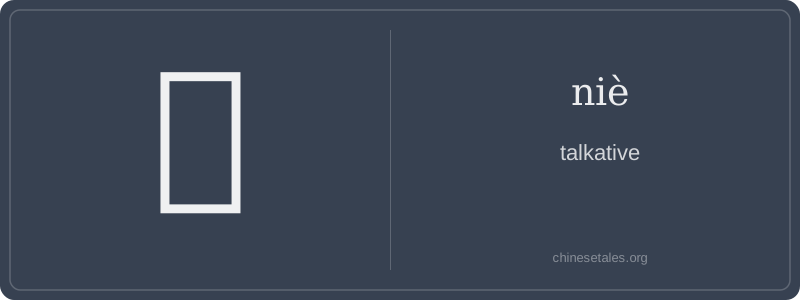
The character 喦 first appeared in seal script (around 200 BCE), not oracle bones — and its form is a masterclass in visual mimicry. It combines three mouths (口) stacked vertically — not side-by-side, but one atop another — evoking overlapping, layered speech pouring forth without pause. Each 'mouth' is rendered with clear, angular strokes: the top mouth is small and tight, the middle slightly wider, the bottom open and bold — suggesting escalation in volume and urgency. Over centuries, clerical script simplified the stacking into a tighter, more compact glyph, and standard script refined the strokes into clean, balanced lines — yet preserved the unmistakable triple-mouth motif.
This triple-mouth imagery directly birthed its meaning: not just 'speaking', but *incessant, overlapping, unstoppable speech*. In the Shuōwén Jiězì (121 CE), Xu Shen defined it as 'yán duō ér fán' — 'speech abundant and vexing'. Classical poets used 喦 to lampoon verbose officials: Li Bai once mocked a pedantic scholar whose lectures were '喦喦如沸鼎' ('chattering like a boiling cauldron'). Even today, the shape whispers its meaning — three mouths don’t debate; they drown out.
Think of 喦 (niè) as Chinese’s linguistic equivalent of a 'chatterbox' — but with the intensity of a courtroom stenographer on espresso. It doesn’t just mean 'talkative'; it conveys *excessive, rapid, often unfiltered speech* — the kind that fills silence like static, or overwhelms a conversation before anyone else gets a word in. Unlike common words like 啰嗦 (luōsuo, 'verbose') or 多嘴 (duōzuǐ, 'meddlesome'), 喦 carries a faintly archaic, almost literary sharpness — like hearing a Ming dynasty satirist describe a garrulous merchant.
Grammatically, 喦 is almost never used alone; it’s strictly a component in compound adjectives or reduplicated forms, most often as 喦喦 (niè niè), where repetition intensifies the sense of relentless chatter. You’ll rarely see it predicatively (*'He is 喦'* is unnatural); instead, it modifies nouns ('a 喦喦 person') or appears in descriptive phrases ('speaking 喦喦'). Learners mistakenly try to use it like an adjective à la 高兴 — but it’s not standalone: no '她很喦' — only '她说话喦喦的'.
Culturally, 喦 hints at classical Chinese’s love for onomatopoeic precision: its sound (niè) mimics the clipped, staccato rhythm of rapid-fire talk — think of the 'tch-tch-tch' of impatient tongue-clicking. Modern usage is rare and stylistically marked: you’ll find it in literary fiction, historical dramas, or ironic internet posts mocking someone’s nonstop commentary — never in casual WeChat chats. Mistake it for a common word, and you’ll sound like a scholar quoting the Shuōwén Jiězì at a dumpling shop.