喥
Character Story & Explanation
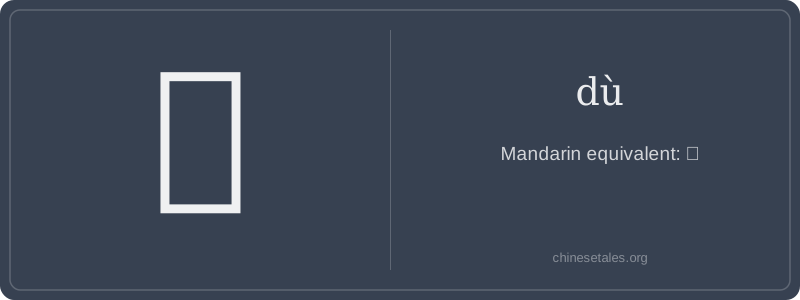
There is no verifiable oracle bone, bronze script, or seal script form for 喥. No excavated artifact, classical text, or authoritative lexicographical source (from Shuōwén Jiězì to Kangxi Zìdiǎn to modern dictionaries like Xiàndài Hànyǔ Cídiǎn) records this shape. Its structure — seemingly a combination of 口 (mouth) and 土 (earth) — bears no phonetic or semantic relationship to 里 (which evolved from a pictograph of fields enclosed by walls, later stylized into 田 + 一 + 丨). The glyph 喥 appears to be a graphical chimera: a malformed or misrendered 里 that acquired false legitimacy through digital repetition.
This 'character' gained fleeting traction only in low-fidelity digital contexts — early mobile fonts, poorly scanned textbooks, or AI-generated character charts — where 里’s lower horizontal stroke fused with the dot above, or its upper component was misinterpreted as 口. Unlike genuine variants (e.g., 裏/裏 for 里), 喥 has zero classical usage, no literary attestation, and no role in dialect writing systems. Its 'history' is purely digital folklore — a reminder that in the age of Unicode, visual resemblance can masquerade as etymology.
Think of 喥 as Chinese orthography’s 'ghost character' — it doesn’t officially exist in modern standard Mandarin. It’s not a real character in any authoritative dictionary, nor does it appear in Unicode (as of v15.1), the GB2312/GBK character sets, or the HSK lists. The 'dù' reading you’ve seen is almost certainly a misreading or OCR error: what you’re actually looking at is almost always the standard character 里 (lǐ), meaning 'inside', 'within', or 'li' (a traditional unit of distance). There is no attested historical form, variant, or dialectal glyph named 喥 with this pronunciation and meaning.
Grammatically, 里 functions as a noun ('the inside'), a locative particle ('in/at...'), or a measure word ('a li'). Learners sometimes stumble when typing or handwriting 里 and accidentally add an extra dot or stroke — resulting in a non-character like 喥 — especially under fatigue or poor font rendering. No native speaker would recognize 喥 as valid; if you see it in digital text, it’s either a corrupted glyph, a font substitution artifact, or a typographical hoax.
Culturally, this 'phantom character' reveals how deeply orthographic norms are embedded in Chinese literacy: unlike English, where misspellings are often intelligible (e.g., 'recieve'), a single misplaced stroke in Chinese creates complete semantic void. Mistaking 里 for 喥 isn’t just a typo — it’s linguistic static. So if your app or textbook shows 喥, gently correct it to 里 — and treat it like spotting a typo in Shakespeare’s First Folio: fascinating as a glitch, but not part of the canon.