喤
Character Story & Explanation
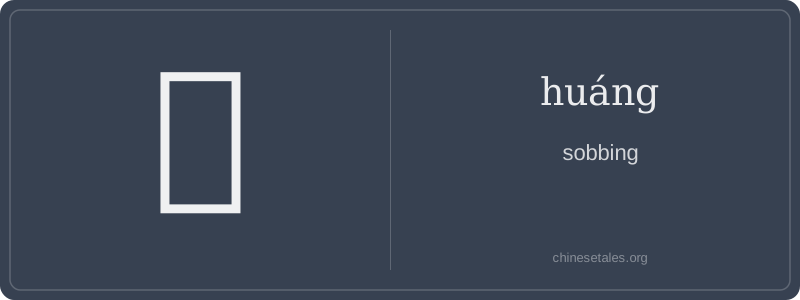
The earliest form of 喤 appears not in oracle bones—but in late Warring States bamboo slips, where it emerges as a variant of 惶 (huáng, ‘anxious’), borrowing the ‘mouth’ radical 口 and adding the phonetic component 皇 (huáng). Its modern shape crystallized by the Han dynasty: left side 口 (mouth, signaling sound production), right side 皇 (imperial, but here purely phonetic—though intriguingly, ‘imperial’ evokes solemnity and suppressed emotion). Visually, the character feels heavy and contained: the ‘mouth’ is tight, the ‘royal’ element towers over it—like grief held in check by dignity.
This visual containment mirrors its semantic evolution: from early uses describing the tremulous voice of ministers addressing the emperor (fear + reverence), it narrowed by the Tang to focus exclusively on the *audible symptom* of overwhelming sorrow—the choked, resonant sob that vibrates the throat. Unlike 泣 (qì, ‘to weep silently’) or 啼 (tí, ‘to cry aloud’), 喤 zeroes in on the physical *sound*, not the cause or volume. It’s cited in the *Wen Xuan* anthology describing a widow’s lament: ‘声啴啴而唝唝’ (shēng tān tān ér gòng gòng)—where 喤’s variant form underscores how intimately sound and sorrow were linked in classical Chinese poetics.
Imagine a quiet, rain-streaked window in an old Beijing courtyard at dusk: a young woman sits hunched on a wooden stool, her shoulders trembling—not with laughter, but with silent, ragged sobs that catch in her throat like a trapped bird. That visceral, breath-halting sound? That’s 喤 (huáng). It doesn’t mean ‘crying’ in the general sense—it’s specifically the choked, guttural, hiccupping sob where words dissolve and breath stutters. Think of it as the *sound signature* of suppressed grief: not tears, but the raw, involuntary vibration deep in the chest and throat.
Grammatically, 喤 is almost always used reduplicatively—most commonly as 喤喤 (huáng huáng)—to evoke rhythmic, repeated sobbing, often in literary or poetic contexts. You’ll rarely see it alone or as a verb; instead, it functions as an onomatopoeic adverbial modifier: 喤喤地哭 (huáng huáng de kū), ‘sobbing huáng-huáng’. It never takes aspect markers (了, 过) or objects—it’s pure sonic texture, not action. Learners mistakenly treat it like a verb (e.g., *我喤了*), but that’s ungrammatical; it’s strictly descriptive, like English ‘wail-wail’ or ‘hic-hic’.
Culturally, 喤 carries classical weight and melancholy elegance—it appears in Tang dynasty yuefu poetry and Ming-Qing narrative verse to heighten emotional gravity without melodrama. Modern spoken Mandarin avoids it entirely (replacing it with 啜泣 chuòqì or 哭出声 kū chū shēng), so using 喤 in casual speech sounds archaic or theatrical. The biggest trap? Confusing its tone—huáng (second tone, rising) with huàng (fourth tone, falling), which means ‘to sway’—a slip that turns sorrow into motion!