喔
Character Story & Explanation
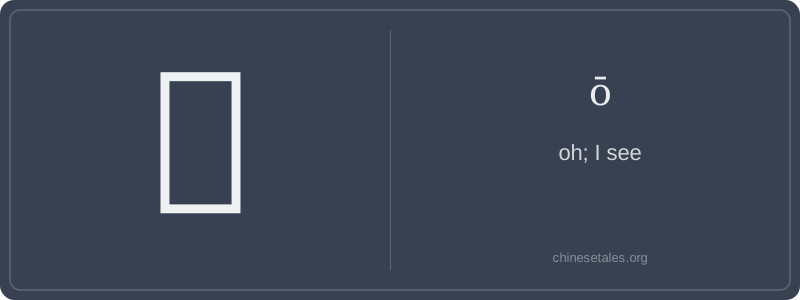
The earliest form of 喔 doesn’t appear in oracle bone or bronze inscriptions — because it didn’t exist as a written character back then. It emerged much later, during the late imperial and Republican eras, as a phonetic loan character created specifically to capture the spoken interjection 'ō'. Its structure is brilliantly transparent: left side 口 (kǒu, 'mouth') declares its domain — vocalization; right side 吾 (wú, 'I/me', pronounced wú but here acting purely as a phonetic hint for ō) provides the sound anchor. Though 吾 itself has five strokes, its simplified visual rhythm — two horizontal lines atop an 'X'-like core — was adapted and stylized over centuries into the modern 喔’s elegant, balanced right half.
This character is a linguistic fossil of spoken language catching up to writing: a sound so essential to daily interaction that scribes *invented* a glyph for it. In classical texts, such reactions were rarely written — emotions were implied through context or formal particles like 噫 (yī) or 哉 (zāi). But by the 20th century, vernacular fiction (like Lu Xun’s dialogues) demanded fidelity to how people *actually* spoke — pauses, sighs, soft 'ō's. So 喔 was born not from ancient ritual, but from the quiet urgency of human connection — a mouth-shaped vessel for the smallest, most human of sounds.
喔 (ō) is pure vocal choreography — not a word with dictionary 'meaning', but a living breath-sound that maps the speaker’s shifting awareness in real time. Think of it as Chinese’s audible eyebrow-raise: it signals sudden comprehension ('Oh!'), gentle acknowledgment ('Uh-huh'), or soft surprise ('Oh... really?'). Unlike English 'oh', it carries zero lexical weight — no noun, verb, or adjective hiding behind it — just raw, unfiltered reaction. Its tone is always high and level (first tone), like holding a single note on a flute while your brain catches up.
Grammatically, 喔 floats freely — never attached to verbs or modifiers, almost never at sentence end unless trailing off thoughtfully. You’ll hear it mid-conversation before a response ('喔,原来如此!'), or as a standalone interjection after someone shares news ('喔——?' with a slight upward inflection for disbelief). Learners often overuse it like English 'oh' in formal writing, but native speakers reserve it for warm, informal speech — dropping it into emails or essays feels like wearing slippers to a wedding. It’s oral glue, not grammatical mortar.
Culturally, 喔 is the sound of relational tuning: it signals you’re listening, processing, and emotionally present — not just hearing words. Mispronouncing it as wō (its rare alternate reading, used only in onomatopoeic contexts like 喔喔叫, 'wō wō jiào' — the crowing of a rooster) instantly breaks the spell. And crucially: never confuse it with 哦 (ò), which is lower-pitched, more skeptical, and far more common — 喔 is rarer, softer, and warmer, like a smile you hear instead of see.